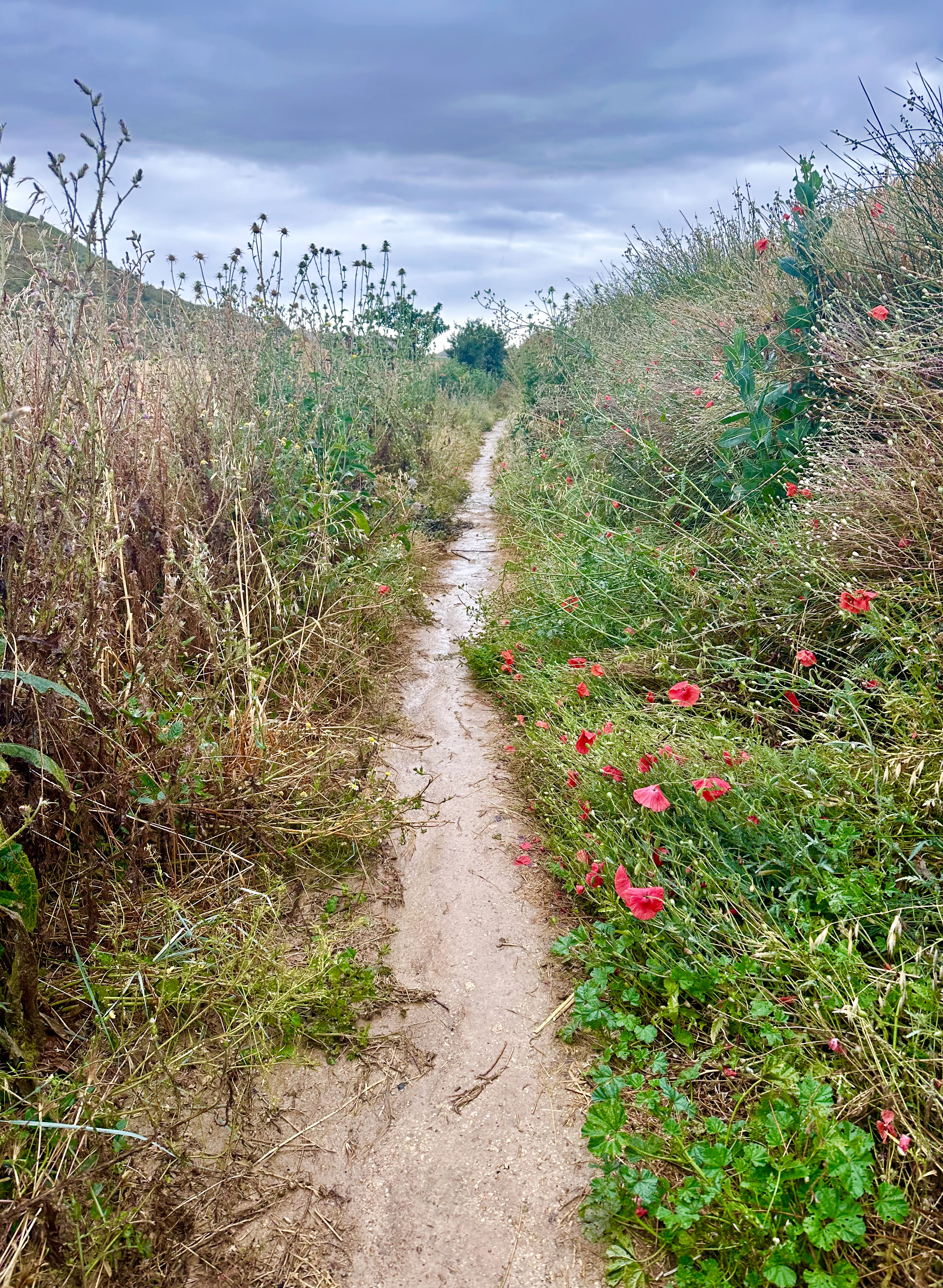
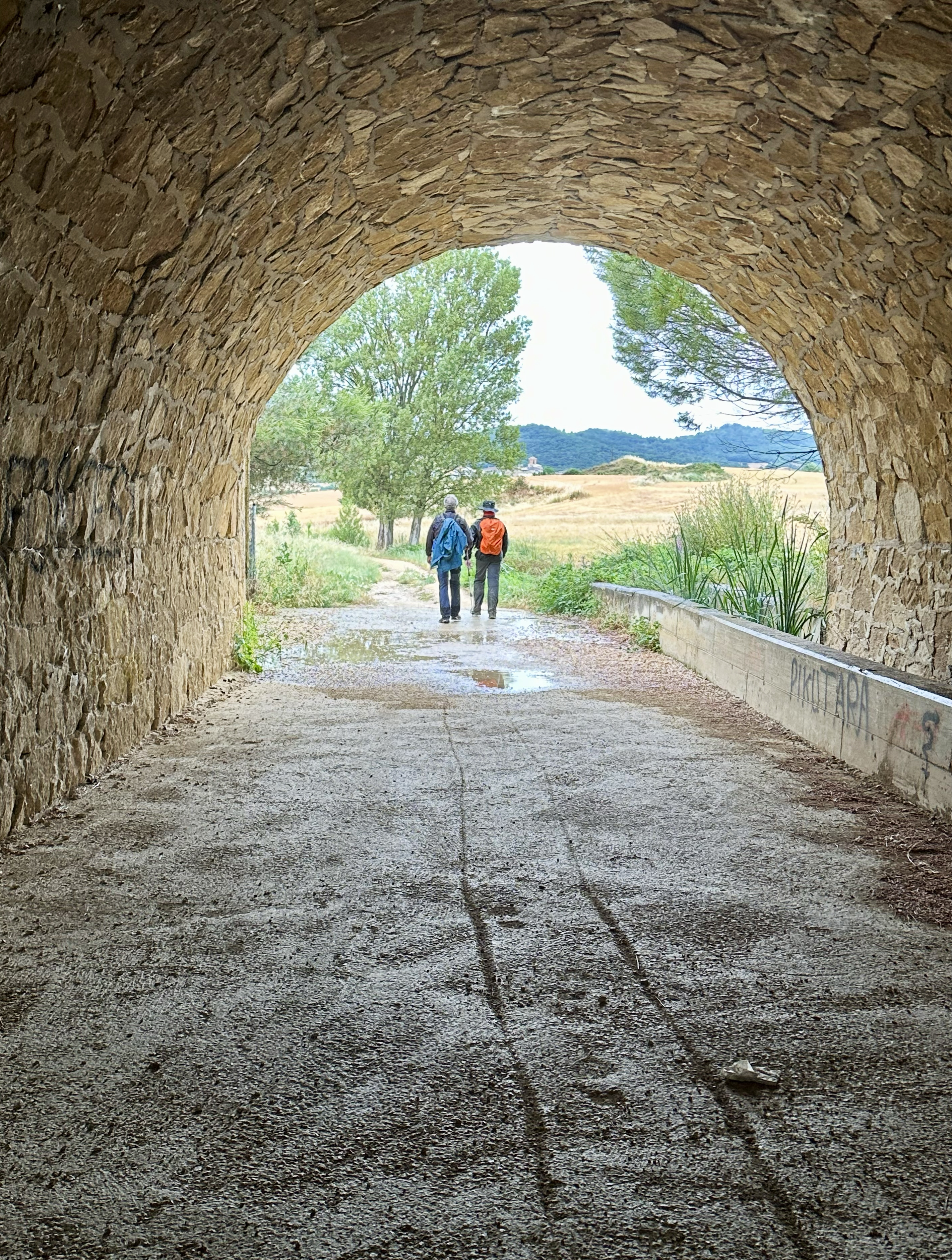
I leave Puente la Reina for this hike of 22 km, under lightning and thunder. The rain continues to pour down for most of the day, causing the roads and paths to quickly turn into rivers and small lakes.
At first I walk on the edges as much as I can to avoid the water. I need to keep my feet as dry as possible, to avoid getting blisters. But as the day progresses and the rain continues, I give up.
Nevertheless, I appreciate today’s stage. The landscape is beautiful and the forces of the weather do not make it any less so.
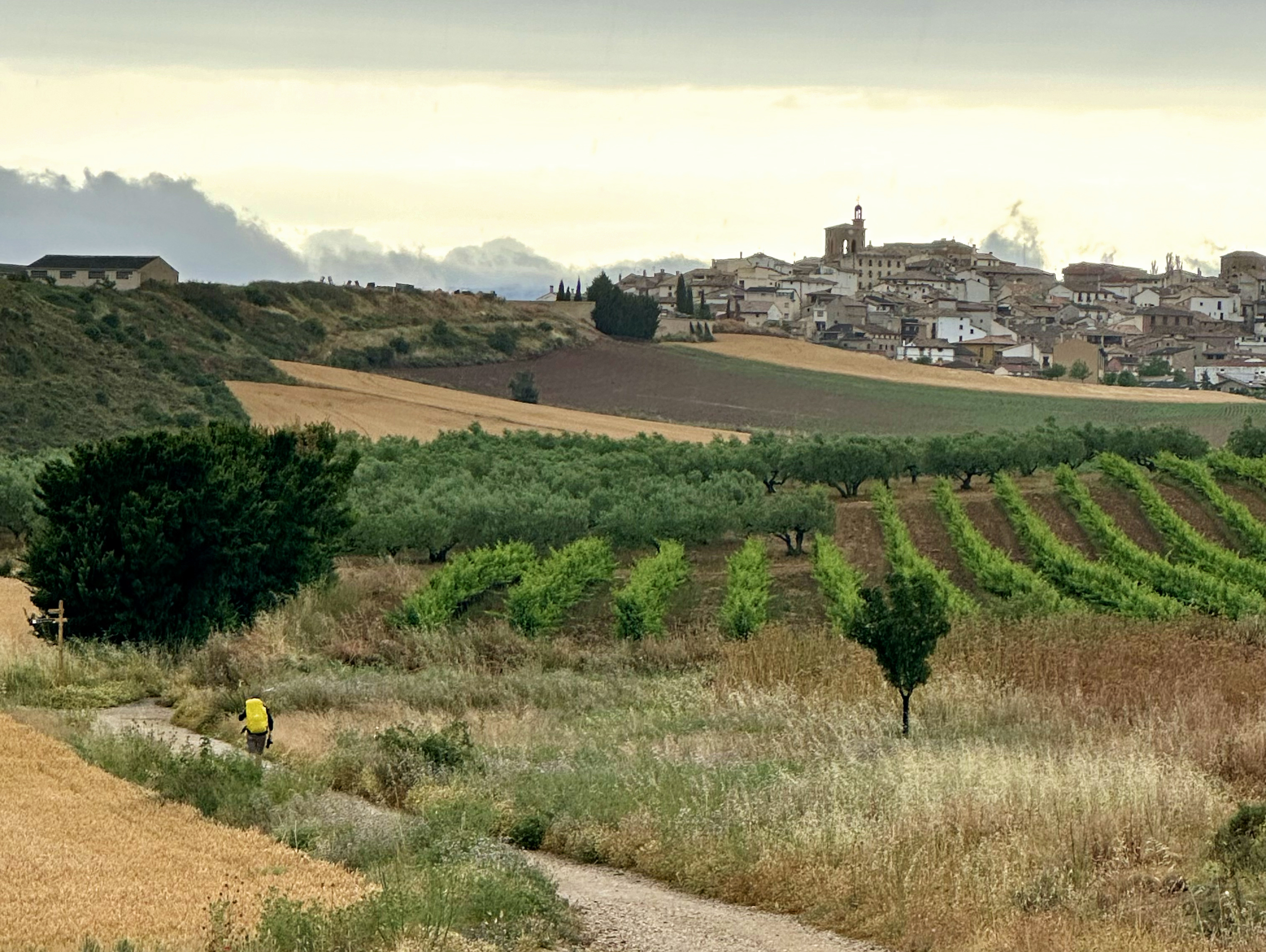
Approaching the medieval hilltop village of Cirauqui. I didn’t run into many pilgrims today except Leonardo from Italy, who I bumped into now and then, whose cheerful yellow rucksack cover was the only reminder of the absent sun.
Waterfalls in the steep alleyways of Cirauqui!
Listen to the rain!
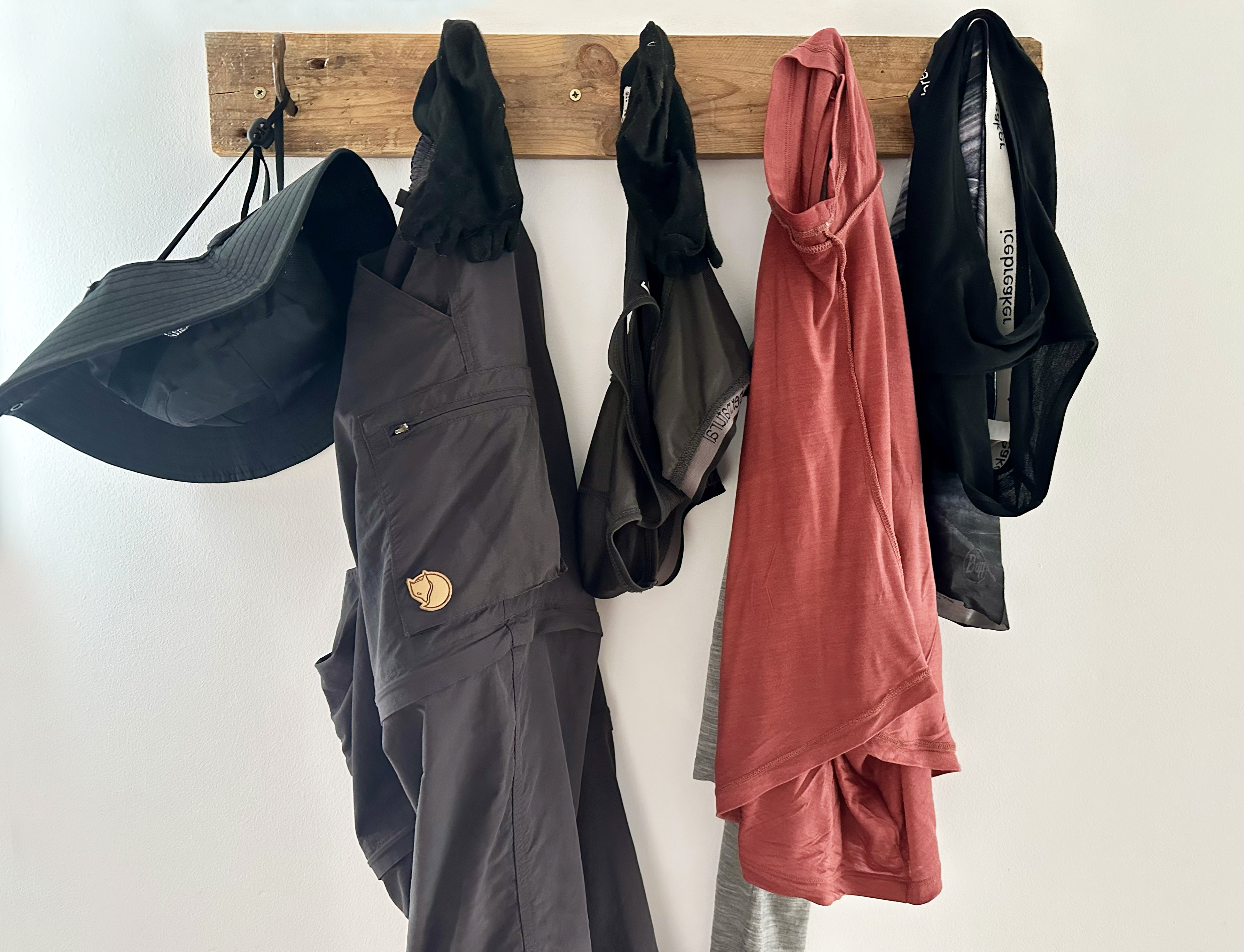
Today’s outfit. The sun hat I bought also turned out to be a perfect rain hat, as it held the hood of the rain poncho in place and the wide brim kept most of the rain off my face.
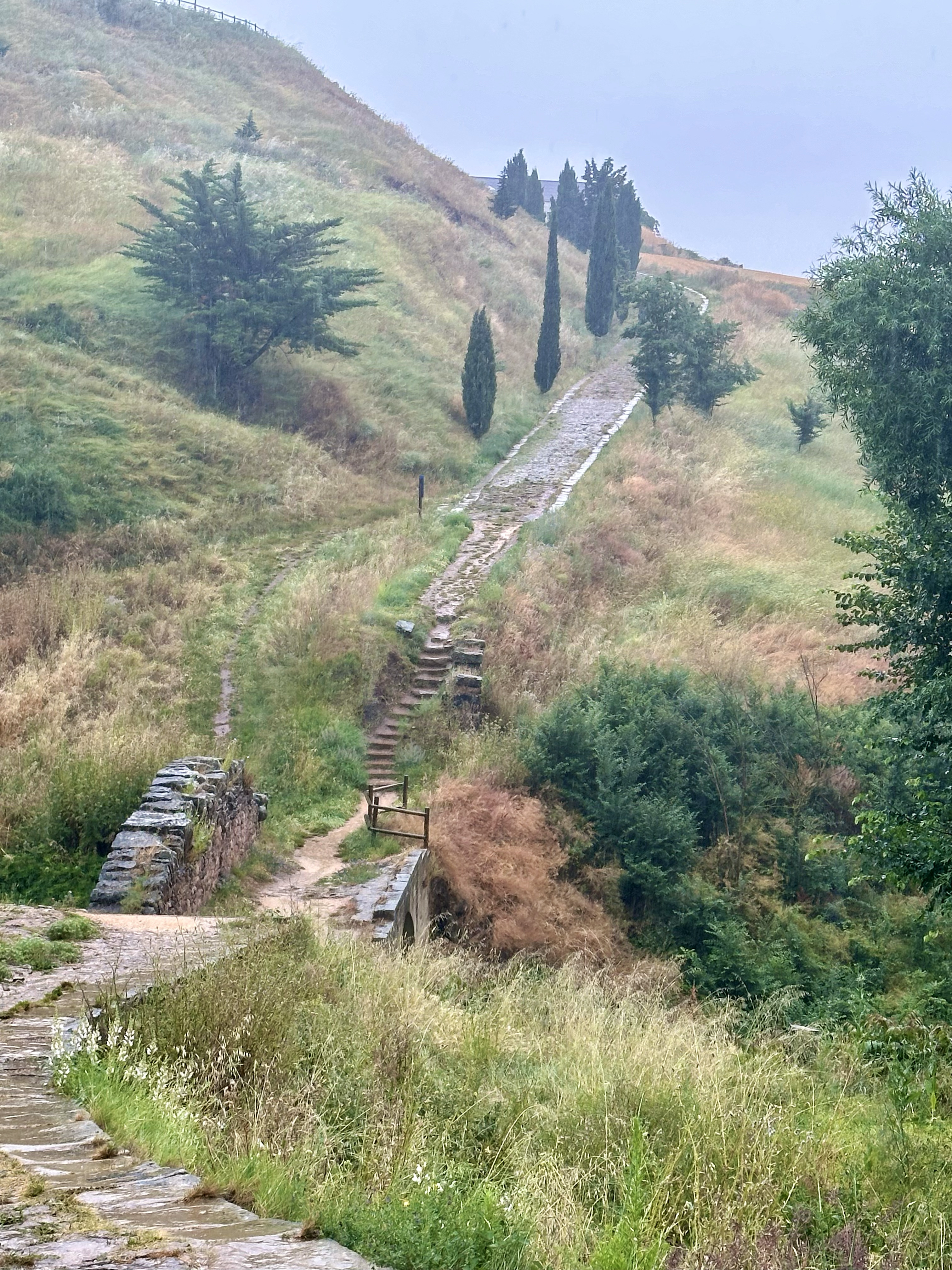
Leaving the village on one of the best examples of a roman road on the camino and I continue over the small Roman bridge.
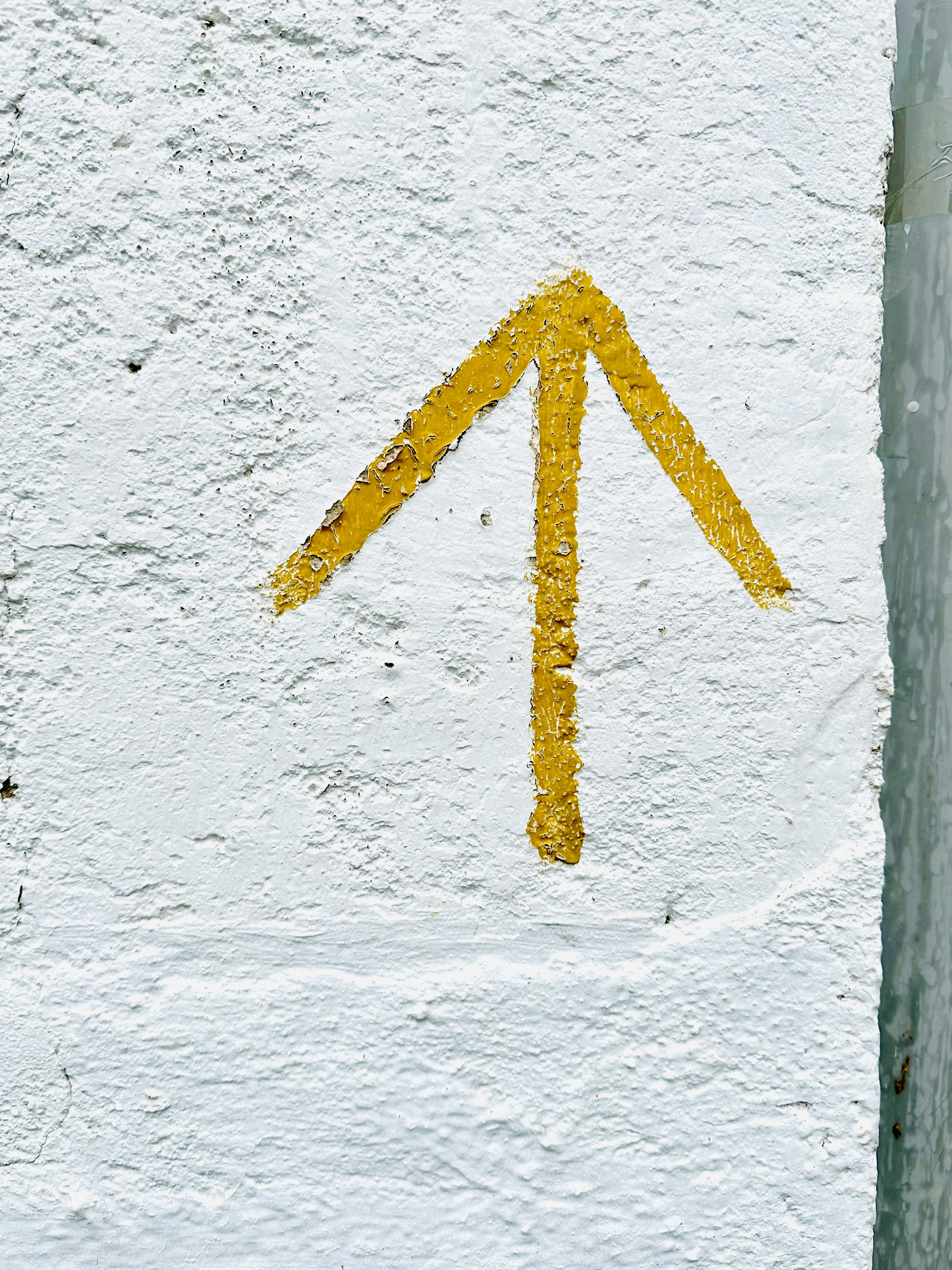
Follow the yellow arrow at all times. The won’t let you down.
Unlike some road signs towards the end which actually showed the wrong distance, and which made the road to Estella feel endlessly long.
At last Estella! Thanks to the rain, I push on and only take very short breaks, so I feel completely exhausted after seven hours of non-stop hiking when I finally stagger into town and my hostel. So, unfortunately I don’t take many photos of Estella or the wonderful Agora hostel which I absolutely love!
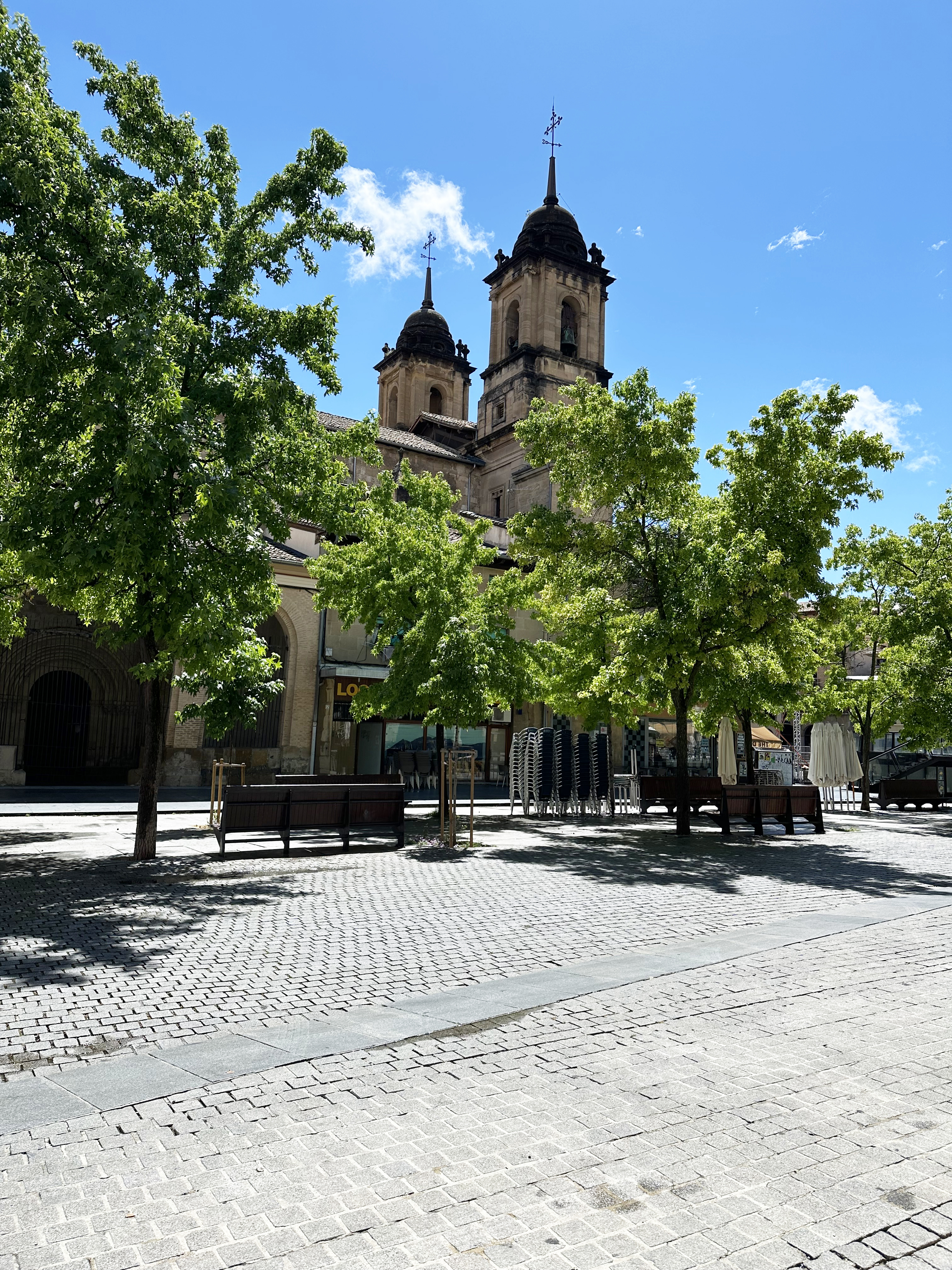
San Juan Bautista on the square where I eventually had a delicious early dinner. I have found that hiking has increased my appetite tremendously and I must eat as fast as possible when I arrive, because I feel famished. Ironically, the rain has stopped and it’s a sunny and beautiful day.
Iglesia San Miguel. This was the sum of what I managed to see of Estella. I head back to Agora where Alfonso has made we a warm welcome, and I plan to have an early night in my very private and cosy bed behind the curtain.
Tomorrow I’m heading to Villamayor de Monjardín, so luckily it’s going to be a short walking day, and I’m looking forward to this!
Check out my earlier posts to get the full context of this pilgrimage and the one I did the year before, and sign up to be notified when the next post is released. If you enjoyed this post, please give it some love by sharing and liking it!
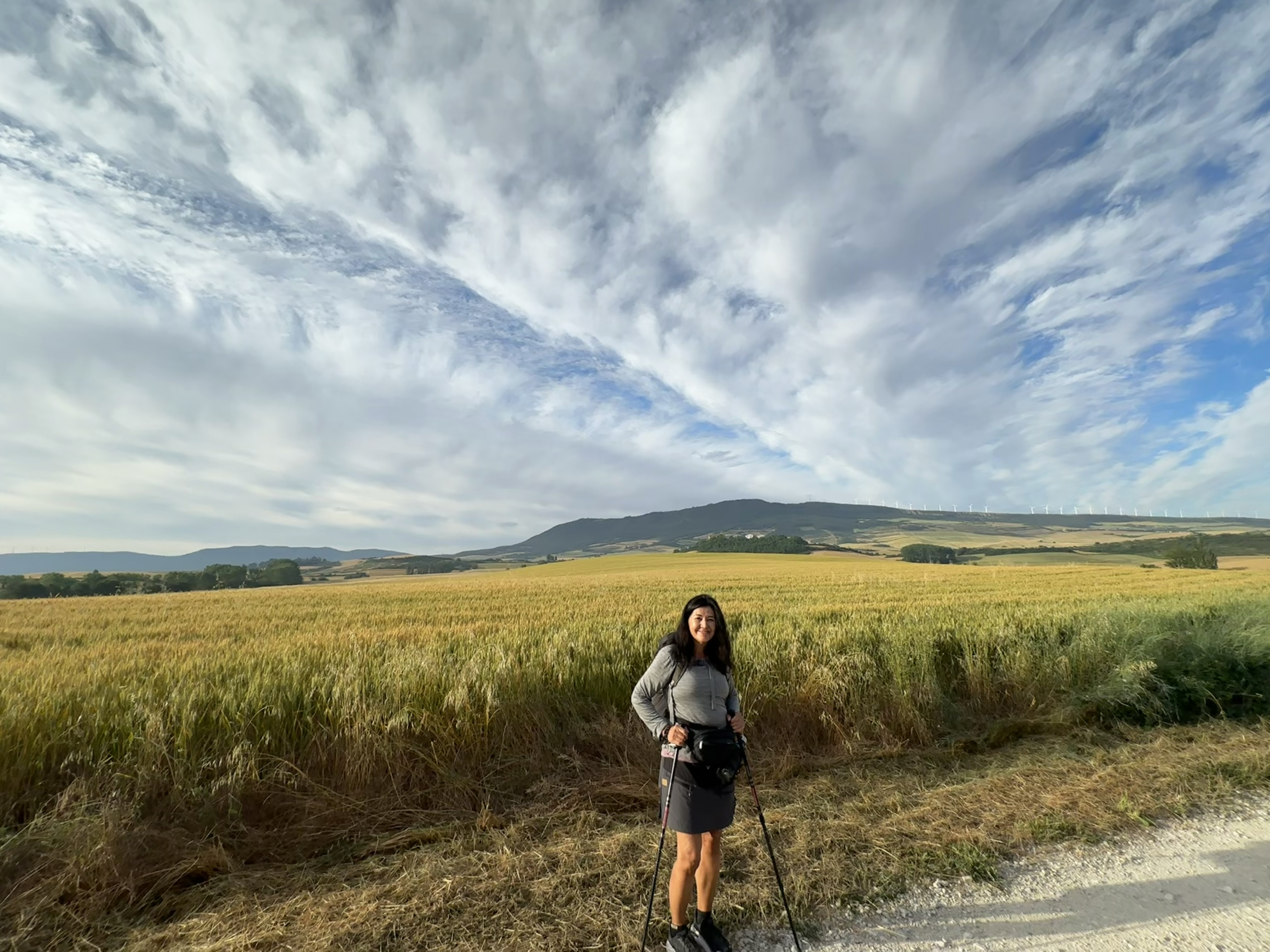
I’m exited to start my camino. This first leg is between Pamplona and Puente la Reina, a distance of 24 km, and I leave the hostel at 6:30. It turns out to be a beautiful day with sunshine, and I’m enjoying myself.
Before I even leave Pamplona, I meet Ricardo from Mexico. I notice him because he is walking very slowly. We team up and eventually find our way out of town. He is also starting from Pamplona and will go all the way to Santiago de Compostela. We share stories and have a good time before I tell him to feel free to move on, as I suspect he really is a fast walker, because he’s just described a religious ceremony in Mexico in honour of St. John involving two days of straight walking 90 km on asphalt, which he has done not once but twice. In the distance we spot the mountain we’ll have to cross to get to Puente la Reina.
On the way at last and feeling very happy!
On the camino I often remind myself to stop and look back at the path I’ve walked. It’s a metaphor we can all apply in life, especially when it feels like a struggle, to look back at what we have accomplished to remind ourselves how far we’ve actually come. Here I’m looking back at Pamplona in the distance.
Approaching the wind turbines on Alto de Perdón.
Finally I reach the top of the mountain which has a height of 790 meters.
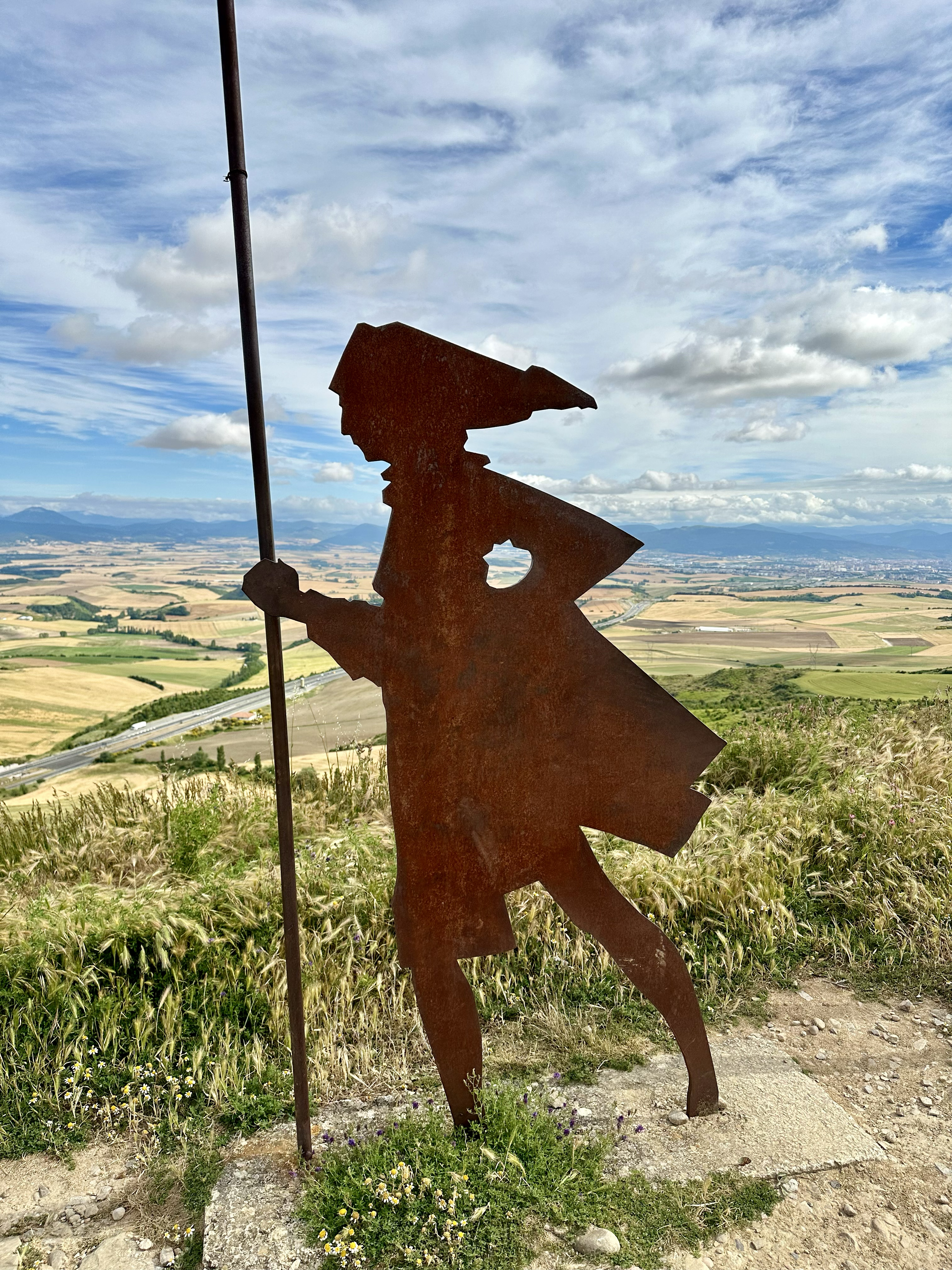
The iconic row of iron silhouettes of medieval pilgrims on the top of Alto de Perdón have an inscription: “Where the way of the wind crosses the way of the stars.”“Donde se cruza el camino del viento con el de las estrellas.”
The view is magnificent and I soak it in for a while before it’s time to head down the mountain.
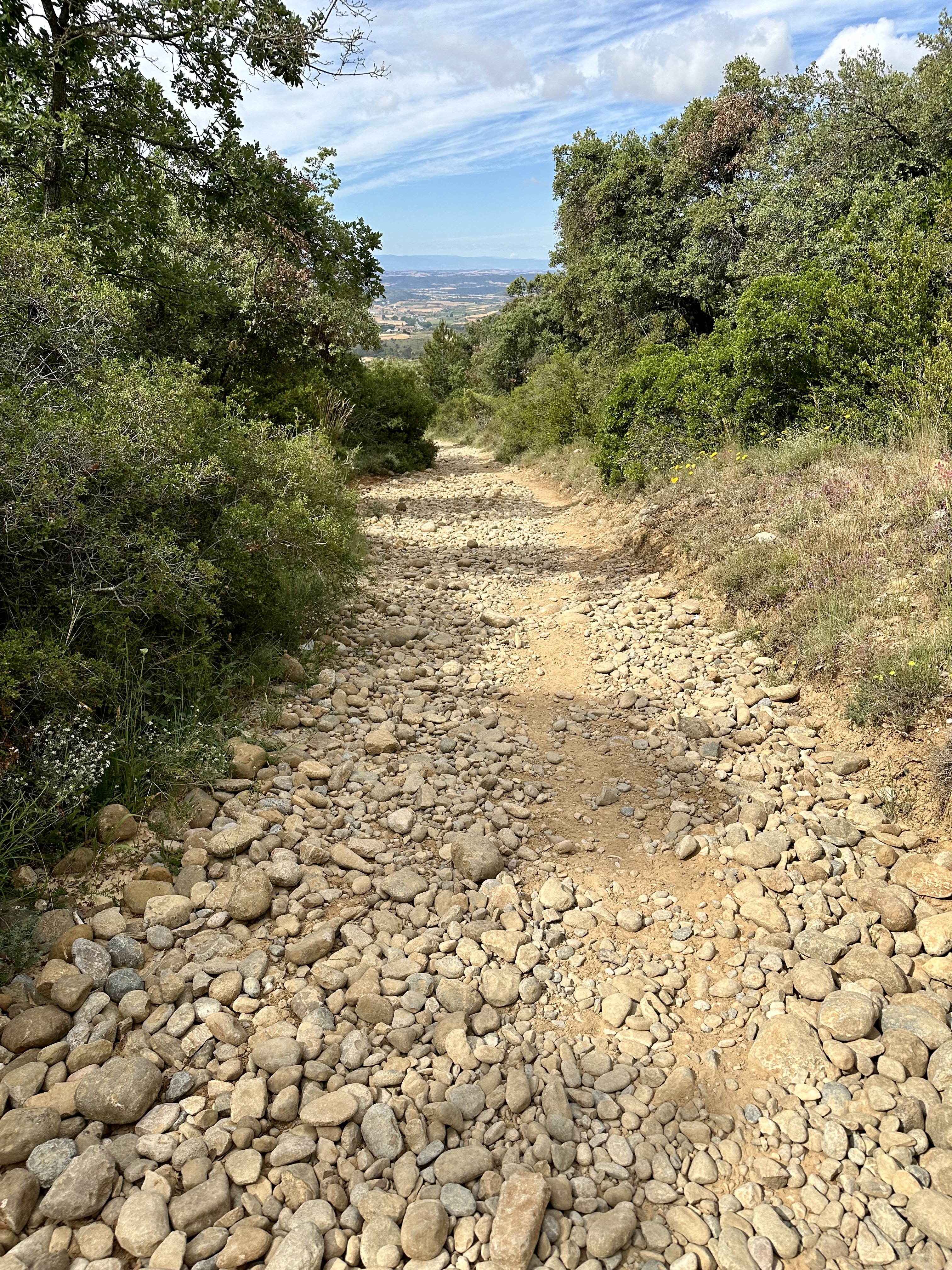
The decline is quite rocky, but honestly, after last year’s horror down the mountain from Foncebadón which was way steeper, this is nothing. But every descent from a mountain really takes a toll on the knees and feet…
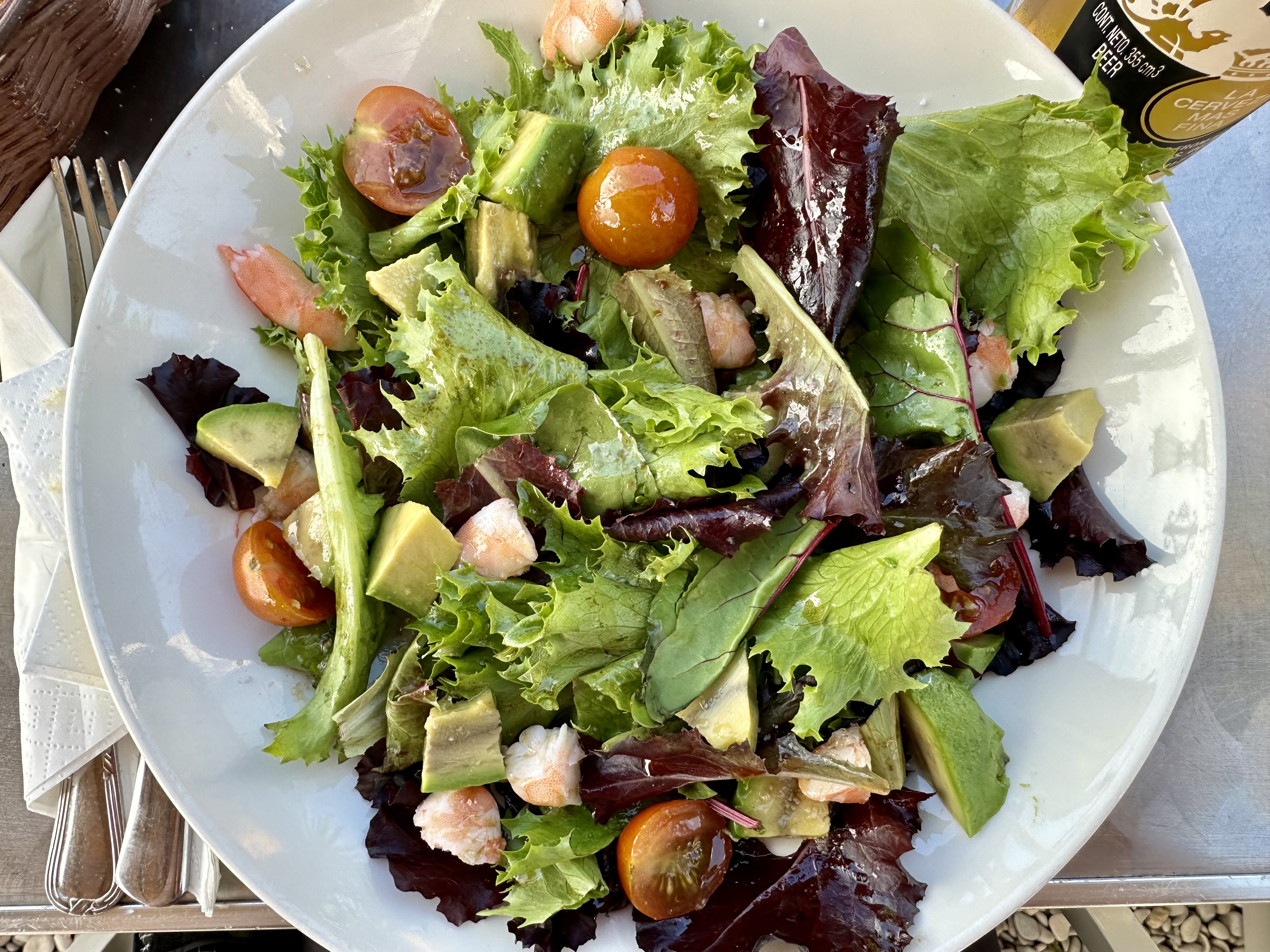
This is the reward! I meet Megan and Jocelyn from the States on the way down, and we continue together to a great restaurant in the hamlet of Uterga where I savour this delicious sallad, the very first and sadly the very last of it’s kind. I never have another one like this which is strange, as I frequently enjoyed fresh salads like this one on the camino last year.
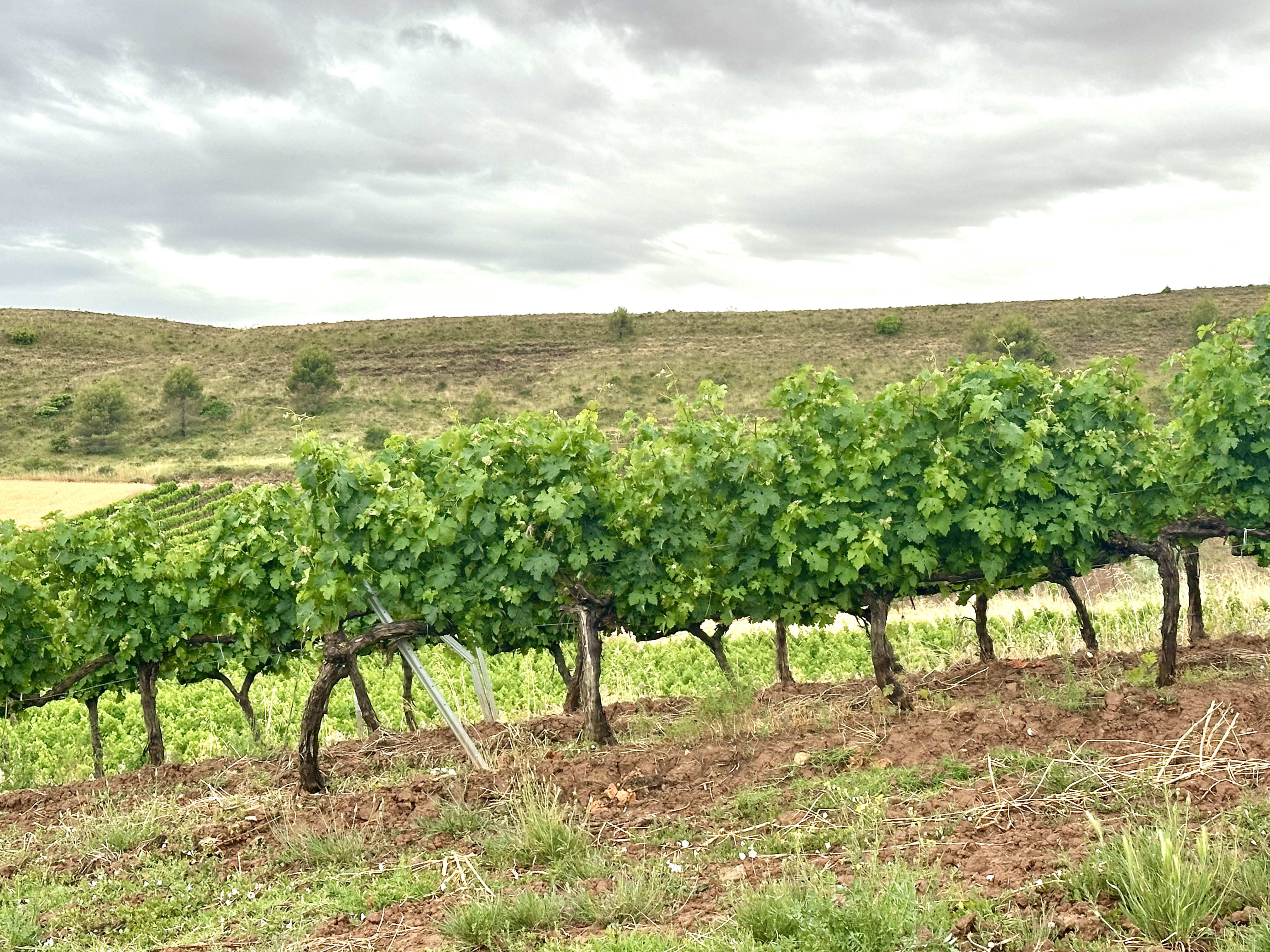
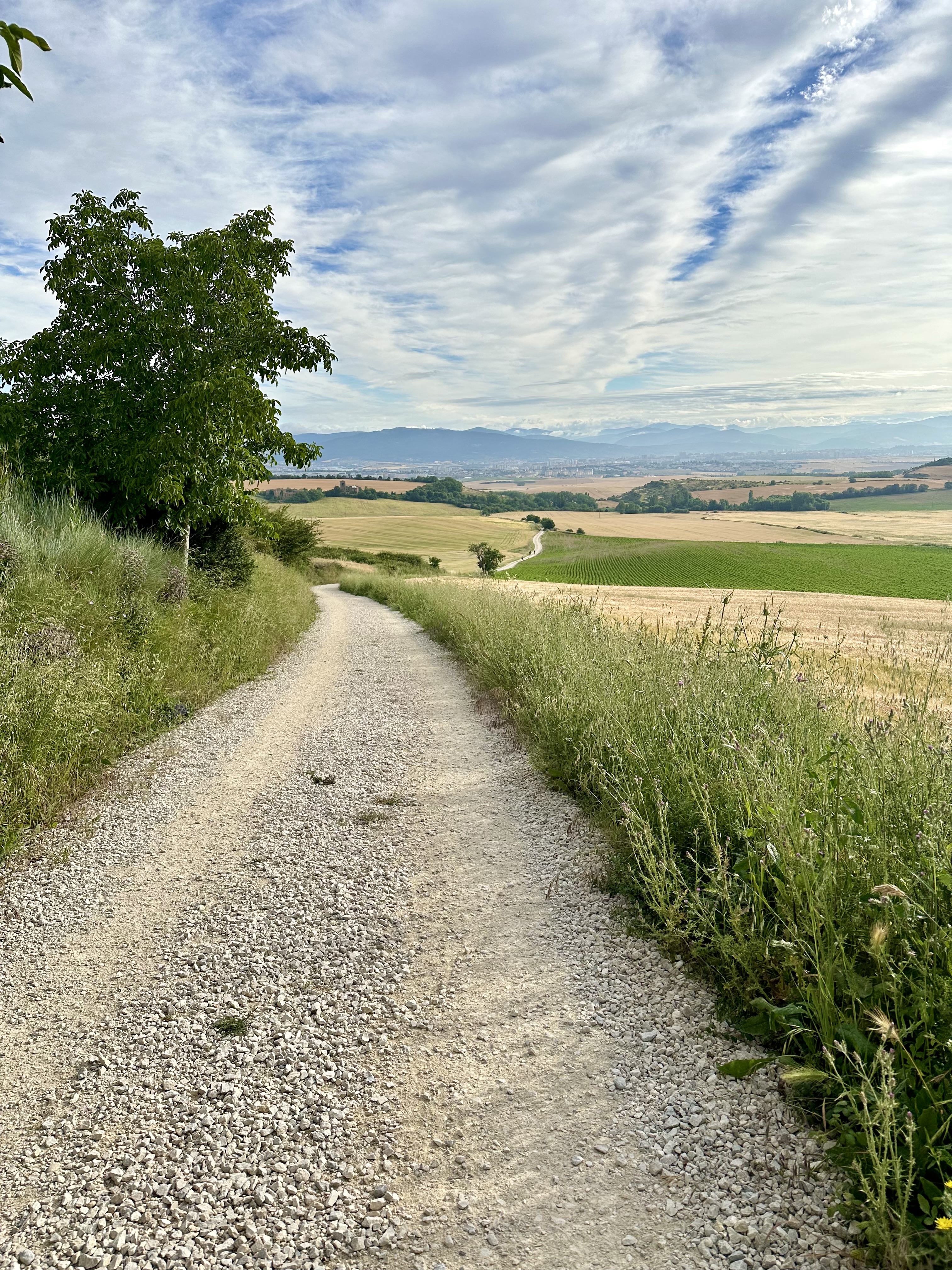
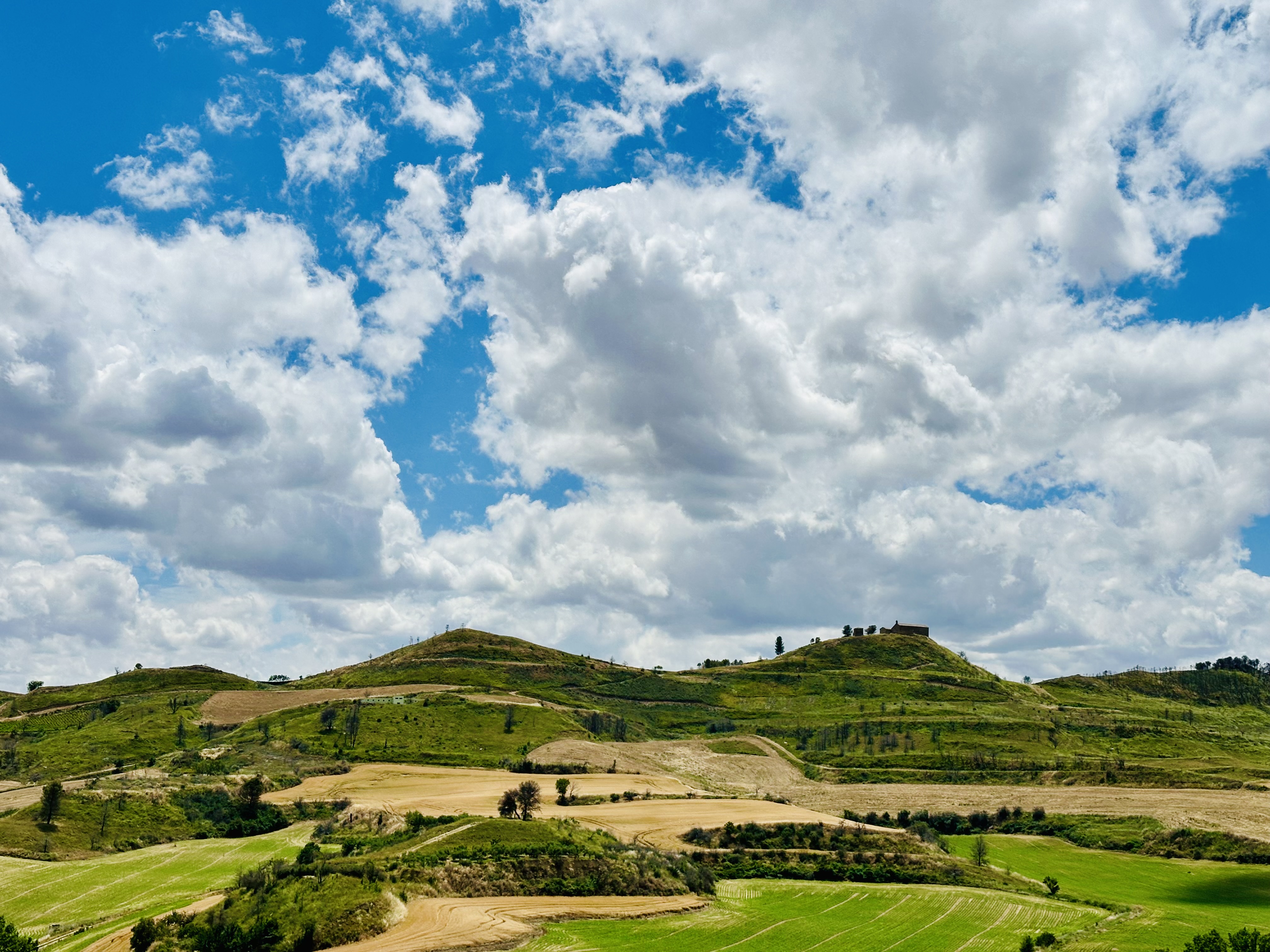
The landscape changes as I came closer to Puente la Reine, with these beautiful rolling hills. We have also entered the wine district of Navarra and vines will become a common sight along the way.
I bought a sun hat made for hiking and it actually feels good using it. Walking the Camino is by no means a fashion statement… It is getting really hot now and there are many hills to tackle. People pass me all the time and I lag behind. But then outside a house a young girl has a small stall. She has jewelry that she has made displayed on a table and then I see a carafe of homemade lemonade that she also sells and I swipe two glasses in a row. I don’t really know what was in that lemonade, but I suddenly filled with new energy and sail past everyone who previously passed me. “It was the lemonade huh?” observes a pilgrim I pass. It was exactly what I needed to get me over the finishing line.
Finally I reach Puente la Reina. I really like this pretty little town, and I also enjoy the luxury of having a very small but lovely private room with my very own bathroom. A hot shower has never felt so nice! I also wash my clothes before going out to explore the town. I’ve lost my sunglasses on the way here and need to replace them, but at this point I’m ravenous and in dire need of a hearty meal. Who do I meet outside a restaurant if not Ricardo, and we spend time catching up while sharing an early dinner on this very street.
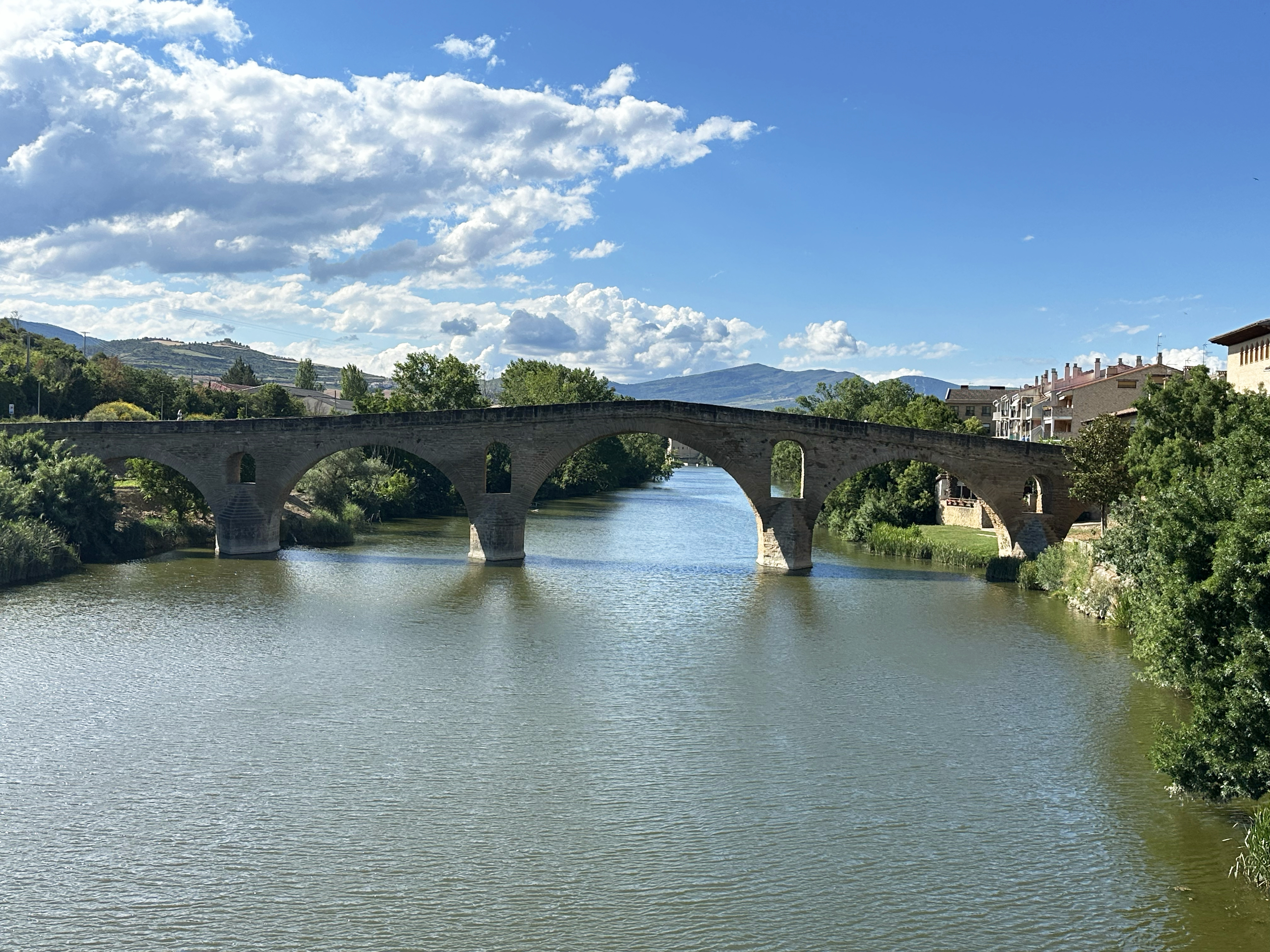
Day one is over and even though I have really comfortable and well-fitting shoes, I still got my very first blisters. But it feels really good to be back on the Camino again! This is the bridge that this town is named after, and it’s on the far side of town where you leave it to get to Estella. This is where I’ll be heading tomorrow.
Check out my earlier posts to get the full context of this pilgrimage and the one I did the year before, and sign up to be notified when the next post is released. If you enjoyed this post, please give it some love by sharing and liking it!
This year I wanted to experience another section of the Camino Frances, and inspired by last year’s cathedral-to-cathedral theme, I chose Pamplona as the starting point and Burgos as the end point.
I arrived from Bilbao completely exhausted, because I spent the night in a hostel there to get a fresh start the next day, or at least that was the idea. It turned out to be a bad decision. Hostels in big cities with no connection to the camino, where everyone is a pilgrim with the same frame of reference, this hostel was full of young people who were partying right through the night and I didn’t sleep a wink.
The Camino spirit begins already at the bus station in Bilbao when I met Hanna, a very nice woman from Sweden, who is also on her way to Pamplona and the hours on the bus fly by as we have so much to talk about. She starts her camino right from the moment we get off the bus, while I make my way to my first hostel, Ahloa.
The hostel I chose in Pamplona is very nice and I share a room with only two other female pilgrims. But I have a couple of errands I need to do when first. One is to get the Camino passport and the other is to buy cheap walking poles and I find them in the nice shop Caminoteca, which I can highly recommend.
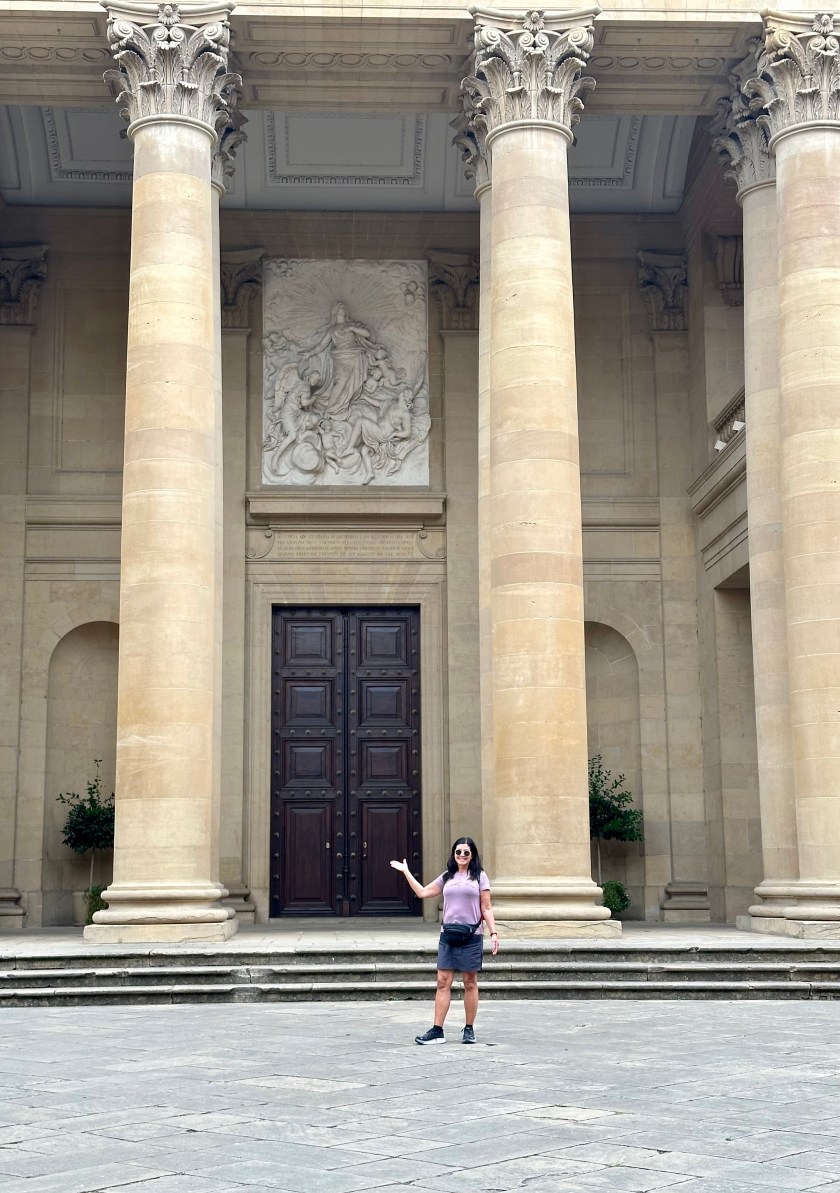
Tired as I am, I want to explore the city a bit and at least see the cathedral. I ask a friendly woman outside if she wants to take a picture of me and the cathedral. Sure, she says. I’m intrigued as she starts walking backwards and doesn’t stop until she’s a good distance away. I had a lot of fun looking at the pictures later. Yes, that’s me there, even if I’m barely visible. But she got the cathedral anyway, which is what I had asked her for and I got the whole courtyard in front as well…
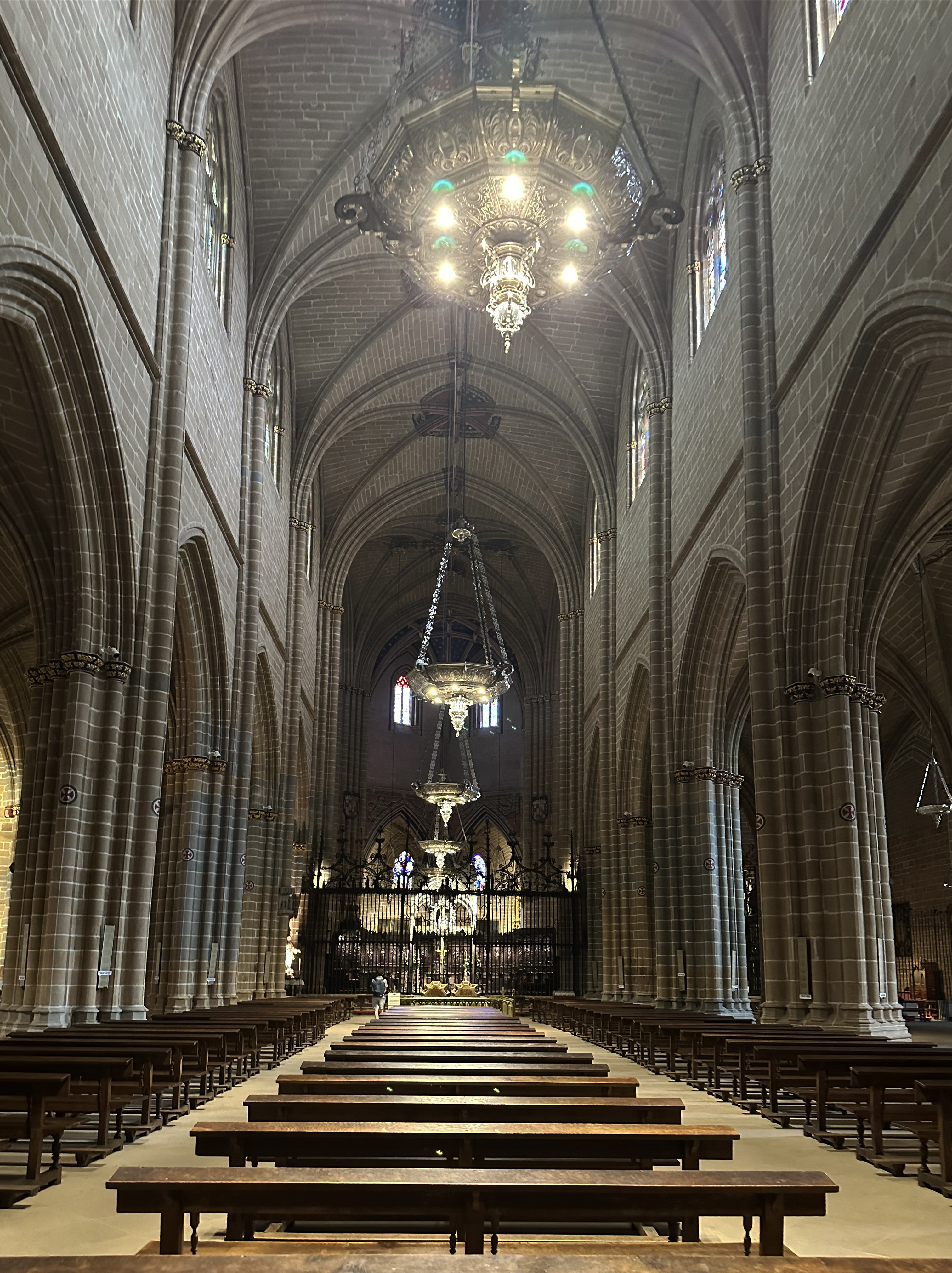
The name of the cathedral in Pamplona is Cathedral of Saint Mary of the Assumption.
A peaceful spot in Pamplona. The gentle sound of rippling water is balm for frayed post-party-hostel nerves.
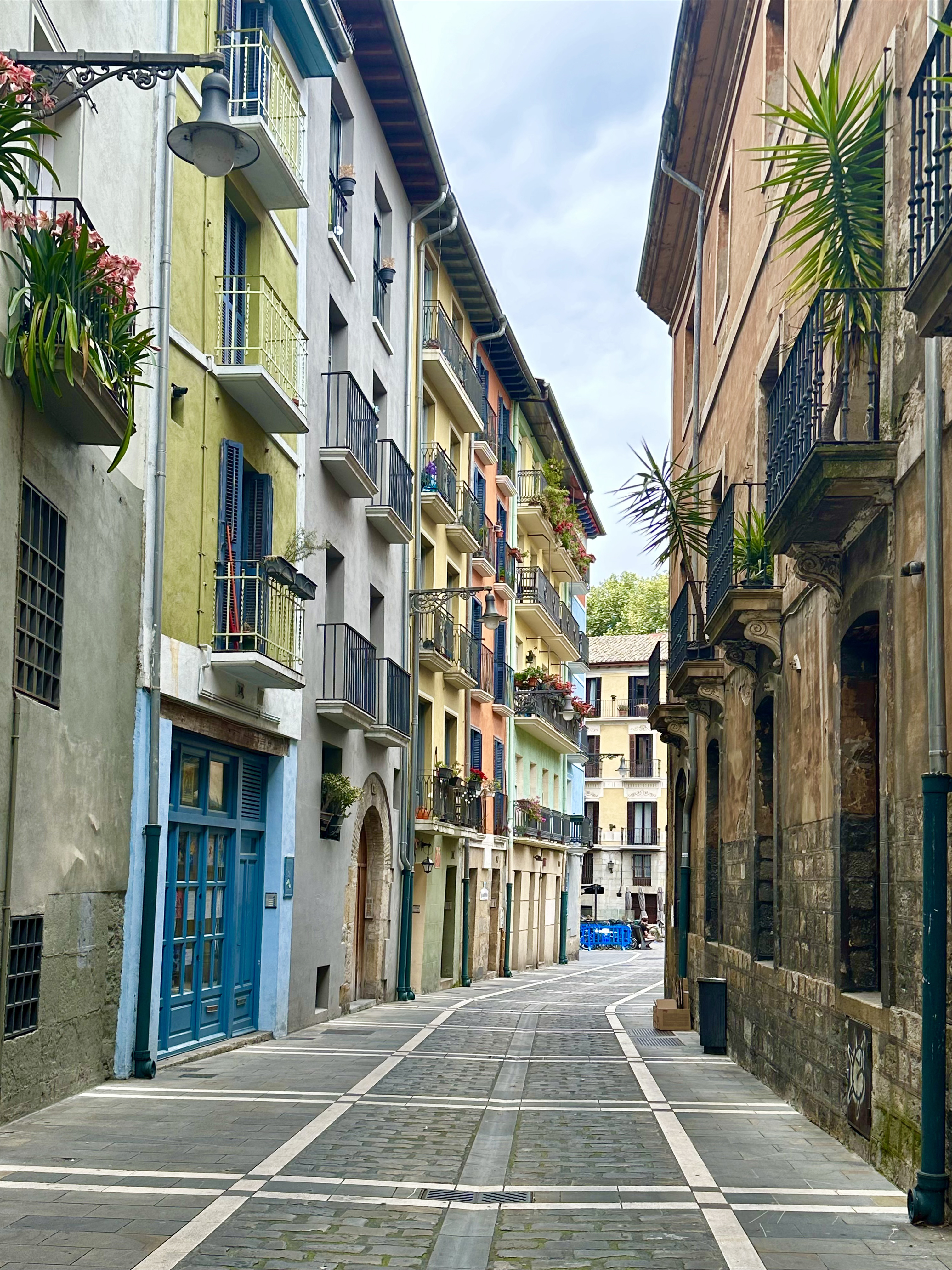
Street view on my way to have an early dinner in Plaza del Castillo before heading back to my room and tucking into bed at half past eight for a good night’s sleep.
Check out my earlier posts to get the full context of this pilgrimage and the one I did the year before, and sign up to be notified when the next post is released.
My ‘John the Scot’ would have been proud of me. I’m up by 4 AM and rearing to go at 5 AM sharp. When I descend the stairs, I find that the lovely Spanish family are all packed and ready too! We head out and it’s pitch-black outside. Never has a purchase felt so good as my new headlamp does now. Outside it’s eerily devoid of other people, even as we pass O Pedrouzo, and we walk for quite some time before daylight breaks and we begin to see anything at all.
The darkness doesn’t bother me, but the teenagers Paula and Maria keep close, especially when a dog jumps up and start barking at us, seemingly coming from nowhere. Luckily there is a sturdy fence between us. We walk all the way past the airport before we come to the first café that’s open, Porta de Santiago. I am grateful to have a much-needed breakfast here, having walked non stop for 13 km, which is halfway to Santiago de Compostela. Here I meet some of my new Camino friends, Wilfried, Ann, and Melek when they pass by.
Perfect walking weather
We continue and the girls and I walk fast and leave their parents behind us. At Monte de Gozo we pass a large albergue, and here I say goodbye to Paula and Maria. They are going to wait for their parents to catch up, so they can enter Santiago de Compostela together.
I’m entering the town now and begin to recognize some of the landmarks. Just before we come into the center I pass a pilgrim, José from Costa Rica, and we team up for the very last stretch. He’s a very nice guy and tells me has hurt his feet and is walking alone, as he hasn’t been able to keep up with his group. At one point we pass a small procession where one of them is playing the bagpipe, and suddenly I feel very emotional.
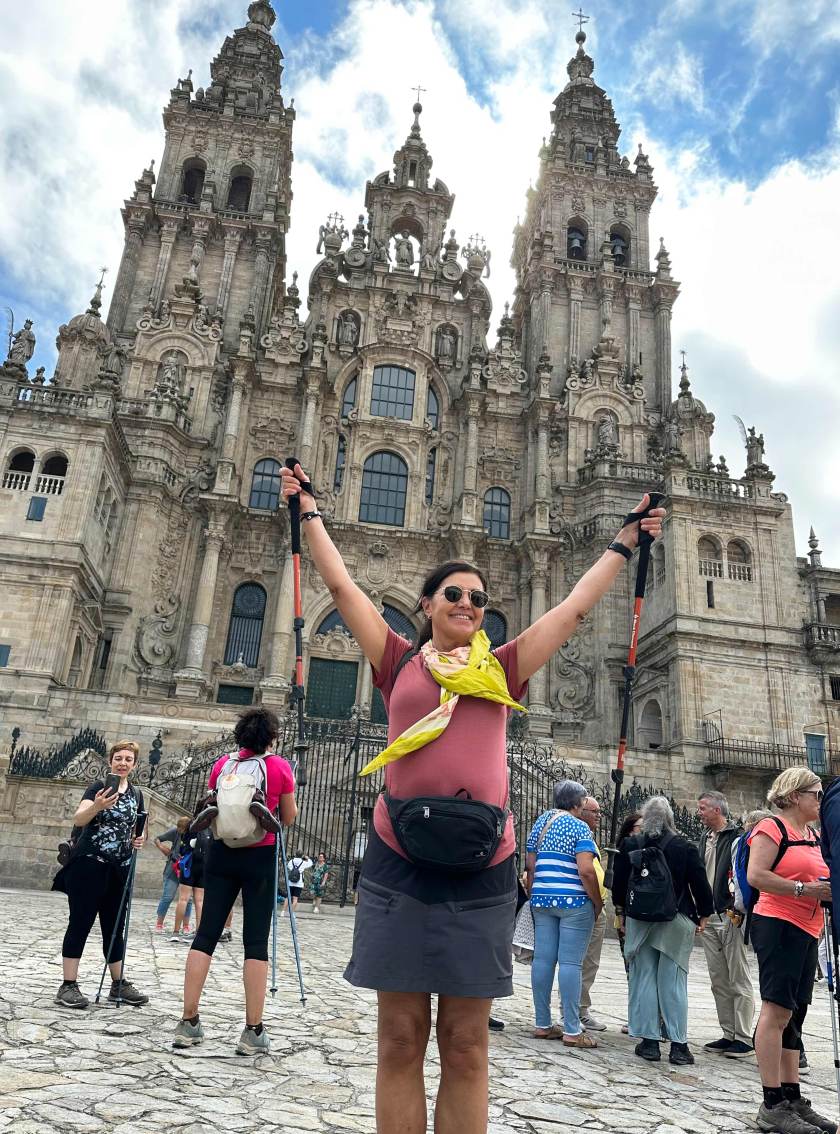
We have arrived! After ironically having to ask for directions for the first time on the very last 100 meters in the throng of small streets, we round the corner and here it is, Praza Obradoiro, the large square in front of the Cathedral. Many different emotions pass at the same time. We take the obligatory photos and grin at each other. Yes! I’m really here! We are joined by the pilgrims that have arrived and still are arriving. As it’s noon and I want to attend the pilgrim mass at 12.30, we say goodbye and I join the que into the cathedral.
Once inside it turns out to be completely full. I see James and greet him and find a small space behind one of the massive pillars. I am extremely aware of my not-so-fresh-from-the-hike state, sandwiched as I am between some elderly presumably local citizens. I can’t see anything of the mass itself that’s going on the other side of the pillar, but turn inward instead.
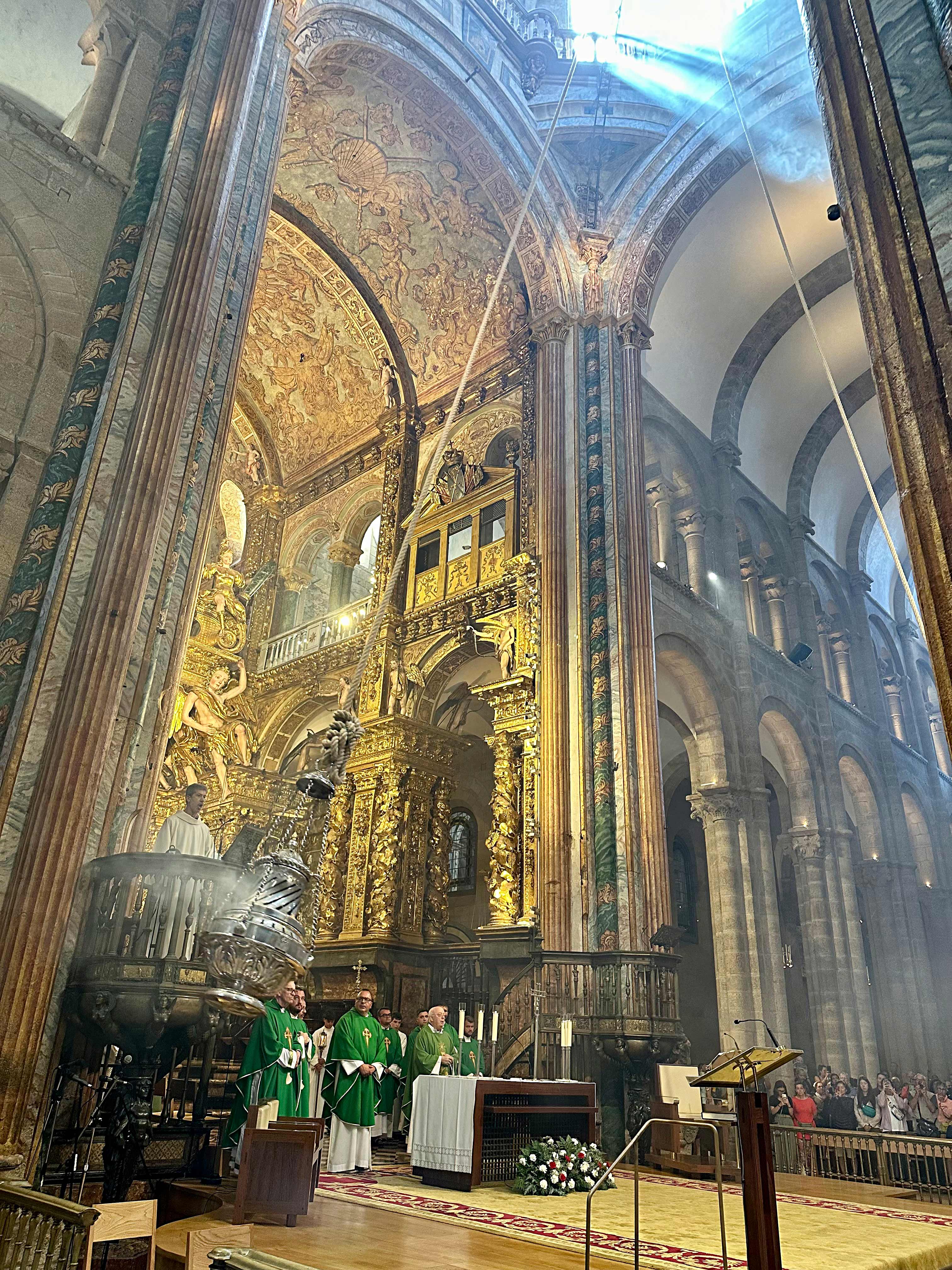
Then a group of cloaked men suddenly appear and move away those of us standing around the pillar, as it turns out to be the very one the Boutafumiero’s ropes are attached to. Now I’m free to move to edge of the nave, and just like that I’m in the very best position to witness this spectacular event.
The Butafumiero
Last time I was lucky enough to see this giant incense burner swinging, but didn’t have high hopes this time as it doesn’t happen at every mass. The tiraboleiros as these six red cloaked men are called, hold on to the ropes and perform the ritual of swinging the Botafumeiro back and forth across the cathedral. This ritual was originally used to disinfect the sweaty and possibly sick pilgrims. It is spectacular to see how it swings all the way up and almost touches the high ceiling of the cathedral. For me, the Mass represents the finale of my Camino. For others who have walked the whole distance, it’s not enough to arrive in Santiago de Compostela to achieve a sense of closure. Many pilgrims therefore continue to hike the Camino to Cape Fisterra and Muxia.
After the mass I find my way to the hotel I’m staying at and check in, have a wonderful shower, and wash my hair. There is a lot of unpacking to do, and I don’t mean clothes. The Camino has so many levels to it, apart from walking different stages. Good thing I’m staying here for another day to land.
The next day I go back to the main hotel to have breakfast, and here I meet Jo, a lovely pilgrim from the US, and we instantly bond. She started all the way in France, from Le-Puy-en-Velay, a French Camino that connects with the Camino Frances at St. Jean Pied de Port and is going to continue to both Portugal and Scotland to continue hiking! What an inspiration she is!
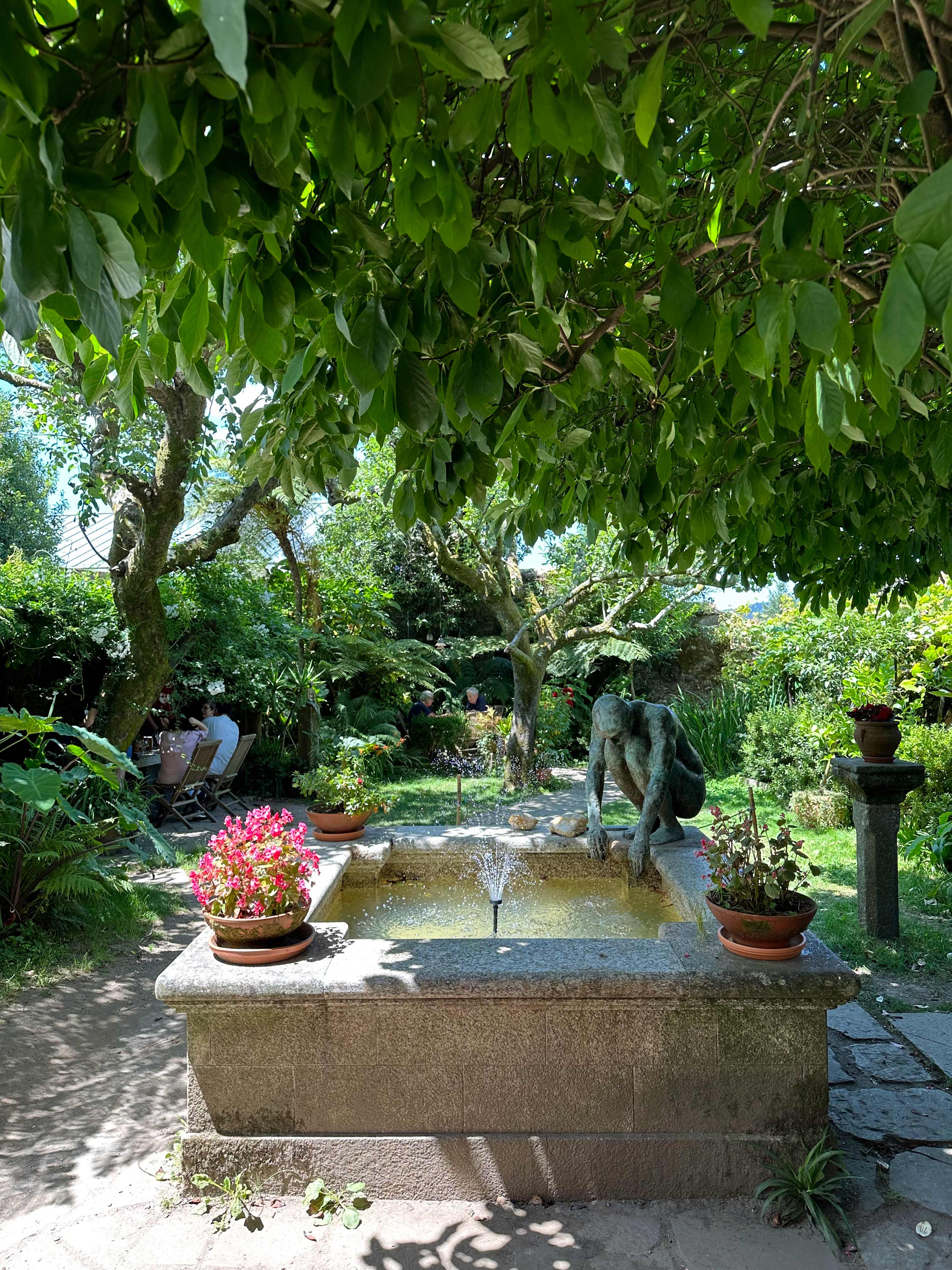
In town I seek out places I remembered from the last time, such as the then restaurant is now the Café Jardin Costa Vella, on Rúa Porta de Pena. It has a beautiful and serene garden with a fountain, a perfect spot to relax and enjoy a huge slice of chocolate cake.
I also find new favourites. The Greenhouse on Rúa da Conga, a vegetarian restaurant just around the corner from me has an excellent Hong Kong noodle dish that I have two days running. I meet up here with Suzanne and Tine on my last night to celebrate.
My Camino has come to an end. Tomorrow a new journey begins. I’m going south to the Italian Riviera to visit my niece. But that’s another story…
These are my own musings and reflections. I highly encourage you to make your own.
Check out my earlier posts to get the full context of this pilgrimage or my latest Camino, and sign up to be notified when the next post is released. If you enjoyed this post, please give it some love by sharing and liking it!
The pilgrimage routes have been here for more than ten centuries as means to go to Santiago de Compostella. The old routes go between the towns because there you were safe. They were not meant to be beautiful or scenic. You walk on tarmac and where ordinary people live and work, but also on paths through breathtakingly beautiful nature.
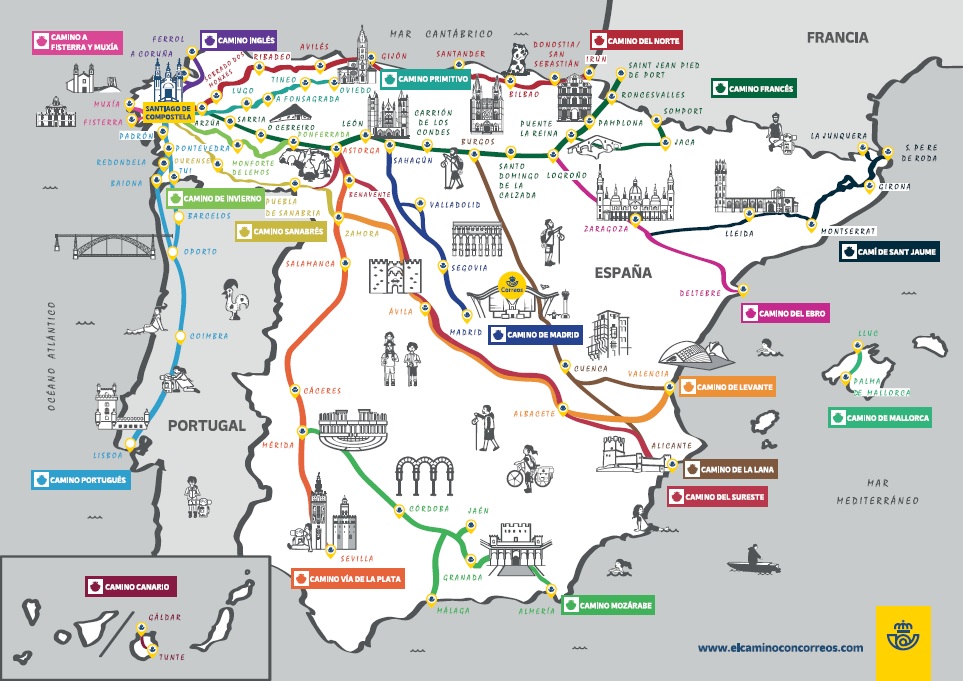
There are many different Camino routes in Spain, all leading to Santiago de Compostela. The Camino Francés is the most popular route, starting from St. Jean Pied de Port in France. Others are Camino del Norte from Irun, Camino Vasco Interior from Irun, Camino Aragones, Camino de Levante from Valencia, Ruta de la Lana from Alicante, Camino de Madrid, Camino Mozarabe from Granada, Vía de la Plata from Sevilla, Camino Portuges from Lisbon, Camino Primitivo from Oveido, Camino Ingles from Ferrol and lastly Camino de Fisterrais, from Santiago de Compostela to Cape Fisterra, once believed to be the edge of the world on the Atlantic coast of Galicia, where you can continue to Muxia. Image credit: https://www.elcaminoconcorreos.com/en/blog/camino-santiago-maps
So, what does it mean to undertake a Camino? Some do their Camino on horseback, others on bicycle, but most walk. Some walk a whole section of a route such as this one, the Camino Frances or the Way of St James as it’s also called, which takes 30 days or more. Other split a route in shorter sections over many years, or only walk a part of a route, and then again others walk the same section they have grown to know and like over and over. There are even pilgrims who walk or bike from their homes in other countries, which is what pilgrims did for many centuries, when there were no other means to reach Santiago de Compostela. It may have begun as Christian pilgrimage, but today people from all walks of life and faiths do their Camino.
Why do people decide to do a Camino? My guess is there may be as many answers to this as there are pilgrims.
Walking the Camino is a journey of discovery, both external and internal. In any case, being able to cover huge distances just using your own legs is amazing. For many, it is a spiritual journey. Some want to explore all the historic buildings and sites. Others for their love of nature and the ever-changing scenarios. Many see the Camino as a path of self-discovery. Some view it as an adventure and want to share this venture with their partner, family, or friends. Others yearn for freedom and need to go solo. Some need to get away from their ordinary life to get clarity on an important issue. People may be grieving, or need to do something physically strenuous to reduce a heavy burden they carry. A few do it because they want to celebrate something big like a 70th birthday. For others, it’s about challenging themselves physically. Or it could simply be a time for a much-needed break from life and being part of a great community.
I just read about a Spanish man who did his very first Camino on bike with a co-worker. The second time he went with his girlfriend who then became his wife. The third time was with his son after losing his job, and the fourth time he went with his whole family. Each time on different routes, with different lengths and in different seasons, but all with a personal meaning, the Camino is an integral part of his life’s journey.
It doesn’t matter if it’s your very first time or if you’re a seasoned repeat walker, if you’re young or in your 70s or 80s, no one leaves the Camino without it having had some kind of impact on their life. Most remember their Camino as, if not life-changing, one of the best they’ve experienced.
My humble take is that anyone who decides to walk the Camino, on this or any of the other many pilgrim routes, is a pilgrim. It doesn’t matter if you are Christian or not, weather you walk alone, in a group, with your dog, ride a horse, or a bike. Sleep in alberges, hostel’s, pensions, hotels, or tents. Whether you carry your backpack or send it with a transport service, because no one knows what burdens anyone is shouldering, carrying his or her backpack or not.
Here I would like to refer to the books written by John Brierley, who sadly passed this very day when I finished my Camino, if you want to delve deeper. His books, which became his life’s work, describe the various Camino routes, and has helped countless pilgrims, including myself, over the many years the books have been around, updated and reissued.
The Camino de Santiago is a pilgrimage rooted in medieval origins. It leads to the tomb believed to be that of the Apostle Saint James the Greater, in the crypt of Santiago de Compostela Cathedral. The Camino was, and still is, Europe’s oldest, busiest, and most well-known route.
In the morning I make the decision to take a day of rest. It’s not so much my bad knee that has swollen up and still hurts that is crucial. After many intense days of walking in wonderful company, surrounded by the extraordinary spirit of community that the Camino so generously provides, I feel the need to pause and wait for my soul to catch up and reconnect with my own Camino, because in tomorrow is the day I arrive in Santiago de Compostela, and it is an important day for me.
I’m pleased to have come to this conclusion and head across the road to see if there is any breakfast to be had. Here I find Tine, who is trying to find plane tickets home, and after a while Suzanne arrives, who also has problems with her feet and is now taking shorter day stages.
Eventually I gather my belongings and head to O Castro. It turns out to be an excellent decision. My new ‘home’ is a very nice little room in a small, newly renovated stone house with a very large tree, standing a stone’s throw away from the Camino itself. I can see pilgrims passing by from my window. There’s a restaurant just 300 meters away, right next to the Camino, Fernanda who works here, tells me. So, I walk there without my hiking poles, and it feels strange at first to not have this support, which is hilarious as the trail is flat as a pancake. How quickly you get used to things…
Another large and magnificent tree stands beside the restaurant O Ceradoiro and pilgrims sit in the shade where the sunlight filters through its foliage. Here I have a delicious lunch of ratatouille and rice. James, an English pilgrim I have bumped into from time to time, is here too. He told me earlier that he makes a point of always walking alone, and only socialize with other pilgrims in the “in-between times” such as now when he’s having lunch or in the evenings at the albergues. After lunch I stroll back. What a lovely sensation to be strolling instead of hiking. Massive difference!
I spend my day in the garden. A large open barn-like construction with a fireplace faces the garden at the back. It seems to be the perfect place to have barbeques and parties. There is also a huge tree, which I sit and admire, enjoying the beauty of not doing anything at all. There is a famous saying in Italy I learnt from Nicolás, the architect I met when I was staying in Buenos Aires. ‘Il dolce con niente’, meaning ‘The sweetness of doing nothing’.
I’m grateful that I’m highly sensitive. But since I easily absorb other people’s energies, I have to be aware of ways to protect myself from being drained of my own energy. Being by myself helps me integrate my experiences on the Camino. It was a good decision to come here.
Every day we have choices. We are capable of creating new choices for ourselves, or to continue living our lives on routine. We can choose to make decisions from our intellect or from our emotions. If we choose based on our feelings, we get closer to our heart, and choosing the path of the heart rarely leads to error, rather the opposite. Being here on the Camino again comes from a decision made from the heart. I’m grateful that I was able to gift myself this experience again.
O Castro is roughly 5 m further away from O Pedrouzo, where most pilgrims choose to stay before Santiago de Compostela. I need to start walking early to be able to get to SdC and attend the pilgrim mass at 12:30.
Staying here is also a very sweet Spanish family of four. They are horrified when they find out that I intend to leave the house at 5 in the morning and walk in the dark alone. ‘But I have a very good head torch’, I protest. ‘No, we will all leave at the same time so we can keep you company’, answers the mother, who has the same name as my small town in Sweden. So, just like that, I’m part of the Camino community again. Tomorrow Santiago de Compostela!
Check out my earlier posts to get the full context of this pilgrimage or my latest Camino, and sign up to be notified when the next post is released. If you enjoyed this post, please give it some love by sharing and liking it!
The Camino de Santiago is a pilgrimage rooted in medieval origins. It leads to the tomb believed to be that of the Apostle Saint James the Greater, in the crypt of Santiago de Compostela Cathedral. The Camino was, and still is, Europe’s oldest, busiest, and most well-known route.
When I left the house this morning at 6.30 AM, I notice that my left knee is hurting, making me almost limp. Oh no, am I not going to be able to walk today!? This is going to be another long walking day, as it’s 26 km to Ribadiso. Just as I’m leaving town, Melek joins me and I’m pleased to see him, because today I’ve brought with me Frankincense, the essential oil that helps with aches and pains, and he told me his neck is hurting.
We walk till we see a tiny café on the outskirts of the town, and enter. The place looks brand new and is very sweet, with lots and lots of lovely cakes, but it isn’t something you would want the first thing in the morning, so I just have a coffee. Anyway, it serves our purpose, and we sneak behind a corner. The essential oil is not supposed to go directly on the skin, so I’ve also brought a cream based on other essential oils, and we blend these together and treat our respective injuries. Pain, blemishes, chafing wounds, and blisters are part of a pilgrim’s everyday life. As Frankincense has been found to have strong anti-inflammatory effects and is said to have been one of the first gifts given to Jesus by the wise men, I have high hopes that this tincture will help me with my knee today.
We walk together for a couple of hours and chat. The sun has risen and it’s turning out to be another glorious day. ‘Feel free to move on whenever you like’, I tell him, as my pace is slower than his, so eventually he sets off with the enviable speed and ease possessed by those with nearly a month of continuous hiking.
After a while I catch up with Ann, a very nice woman from Brazil I’ve run into a couple of times, and we begin to walk together.
I had planned to stop and have lunch in Melide, a quite large town roughly halfway to Ribadiso, but we get here already at 10.30, and only stop for Ann to try out the Frankincense cure on her ankles which are hurting. Here is the old medieval bridge we cross as we leave Melide behind.
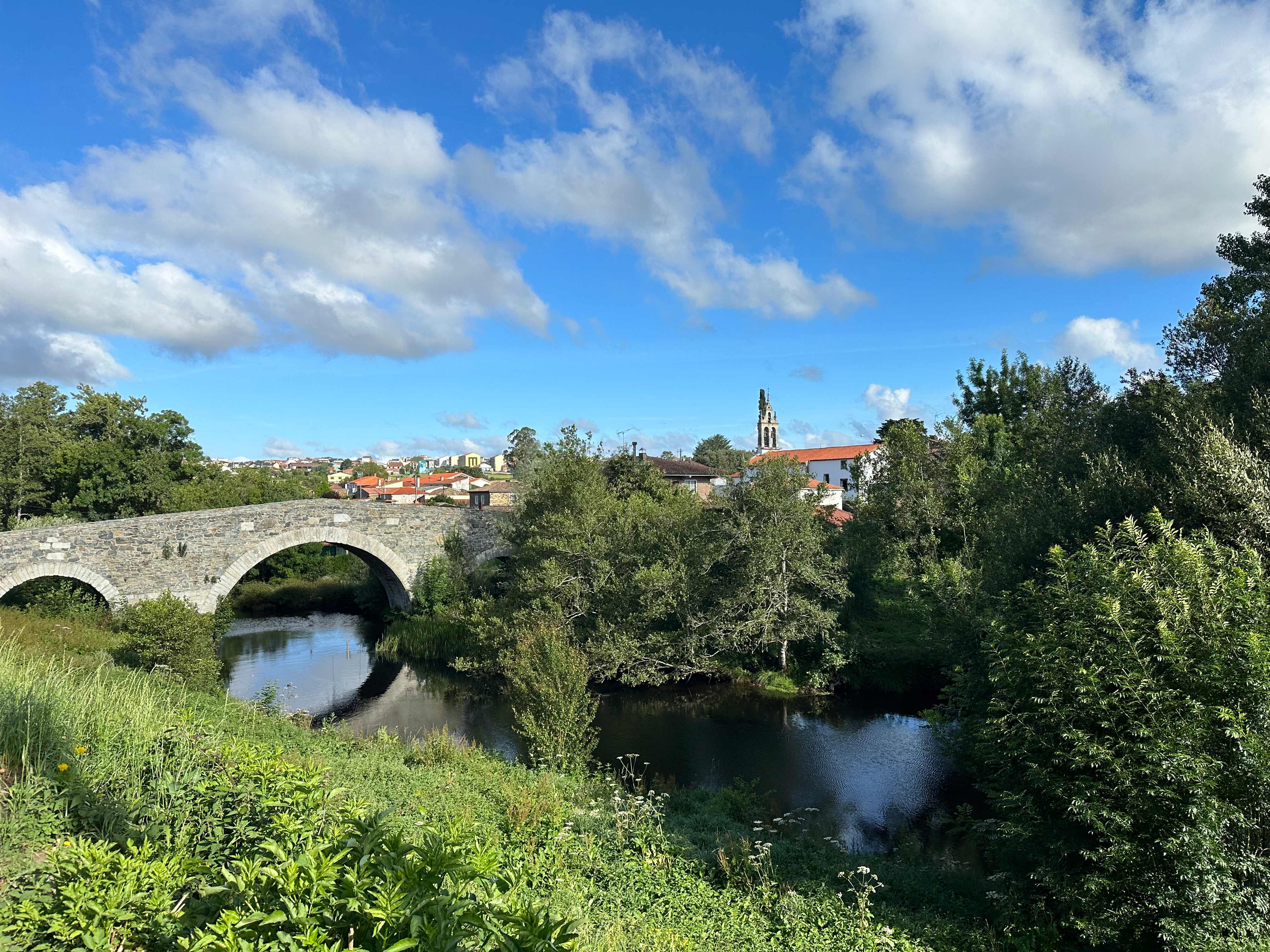
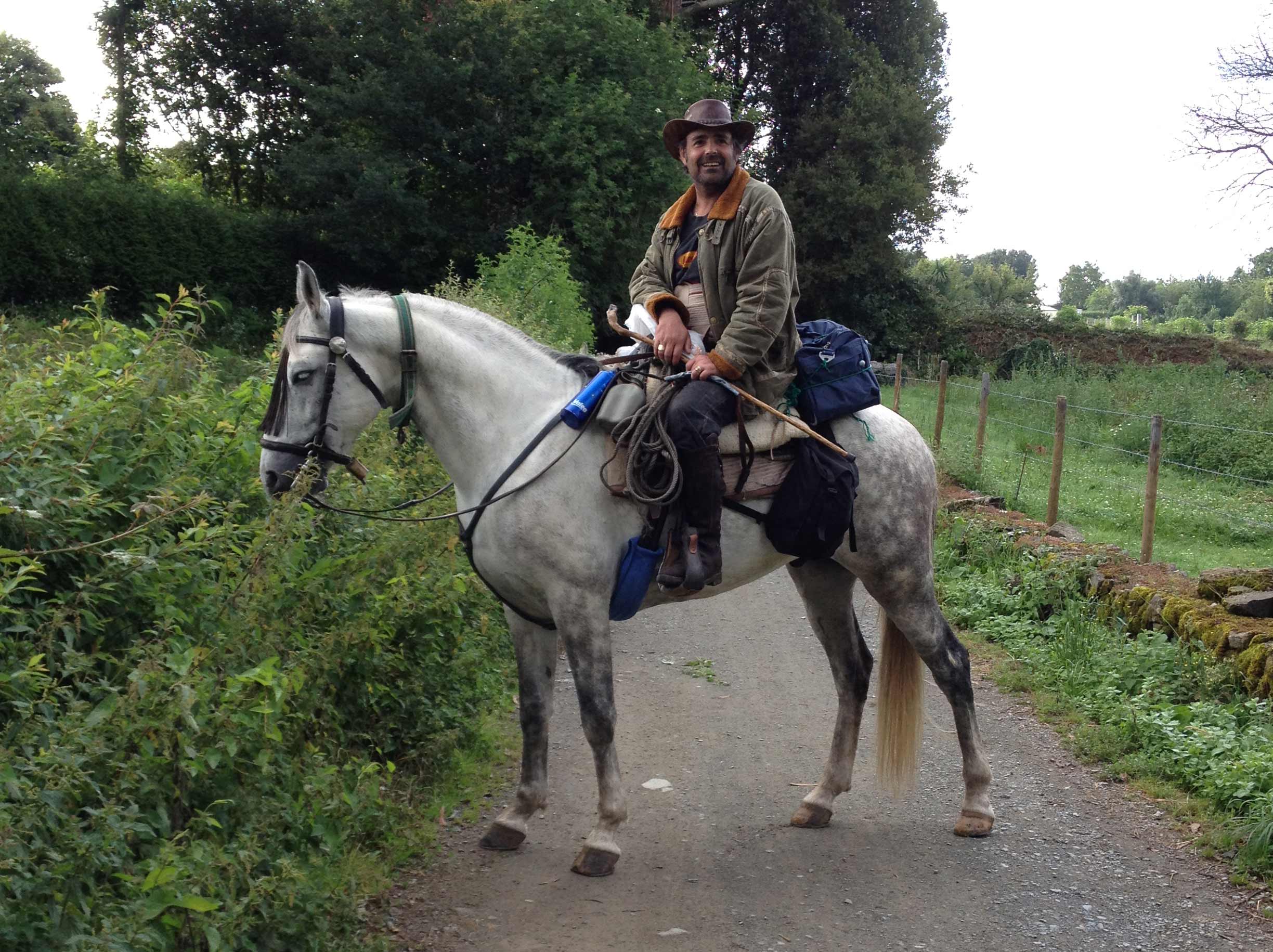
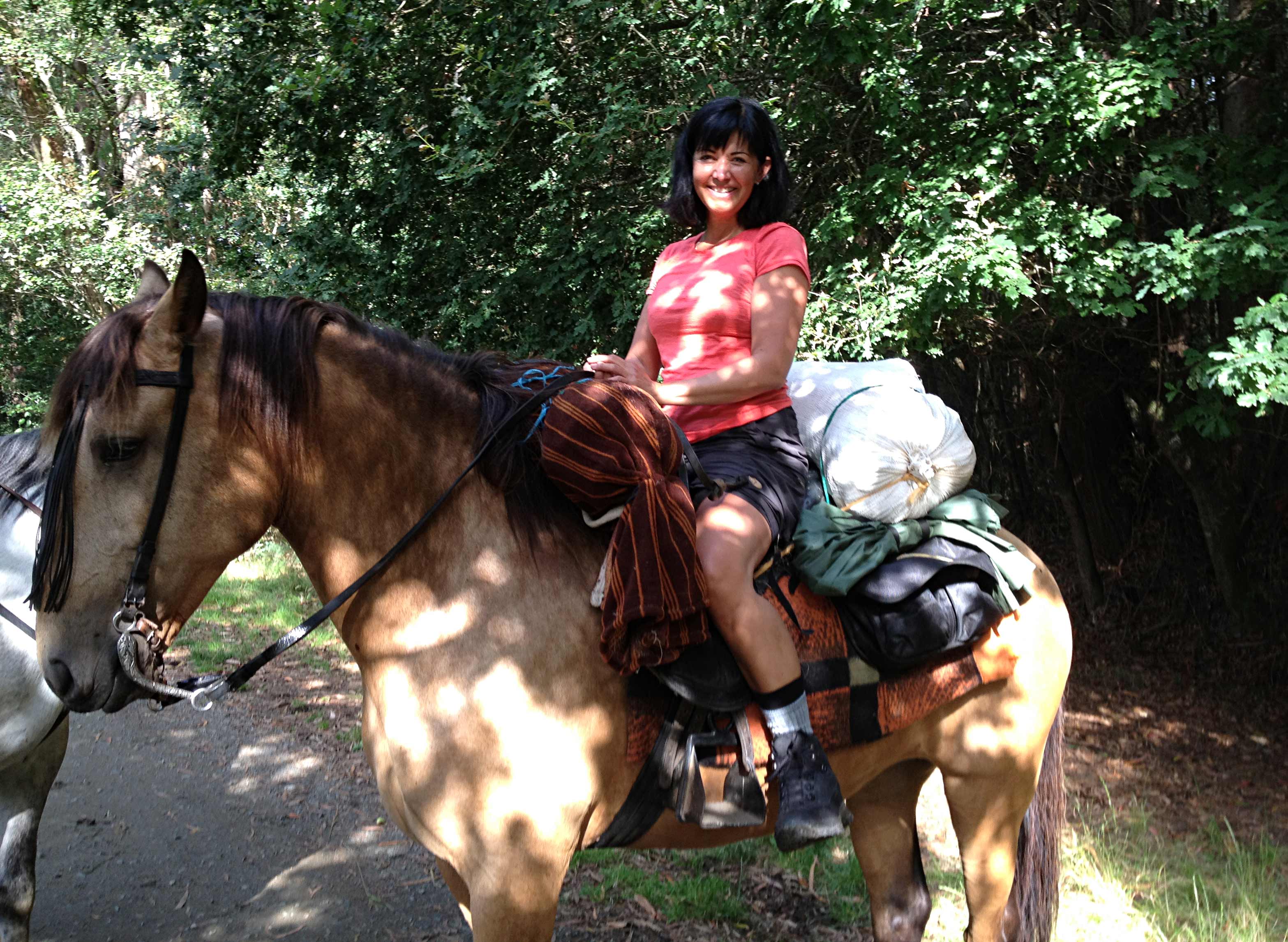
The last time I was here in 2012, I stayed in Melide, having had a rough day and in much need of rest. In the morning I felt much better and left early. In a clearing in the forest just outside town, I came across three ‘cowboys’, watering their horses.
When I stopped to greet them, one of them asked if I wanted a photo taken of me sitting on his horse. ‘Yes please!’ He helped me up and took a photo with my mobile camera. When I was about to jump down, he said, ‘No no no, why don’t you come with us.’ ‘But it’s your horse!’I objected. ‘I can do with a bit of exercise’, he replied and took my backpack and staff, and that was that.
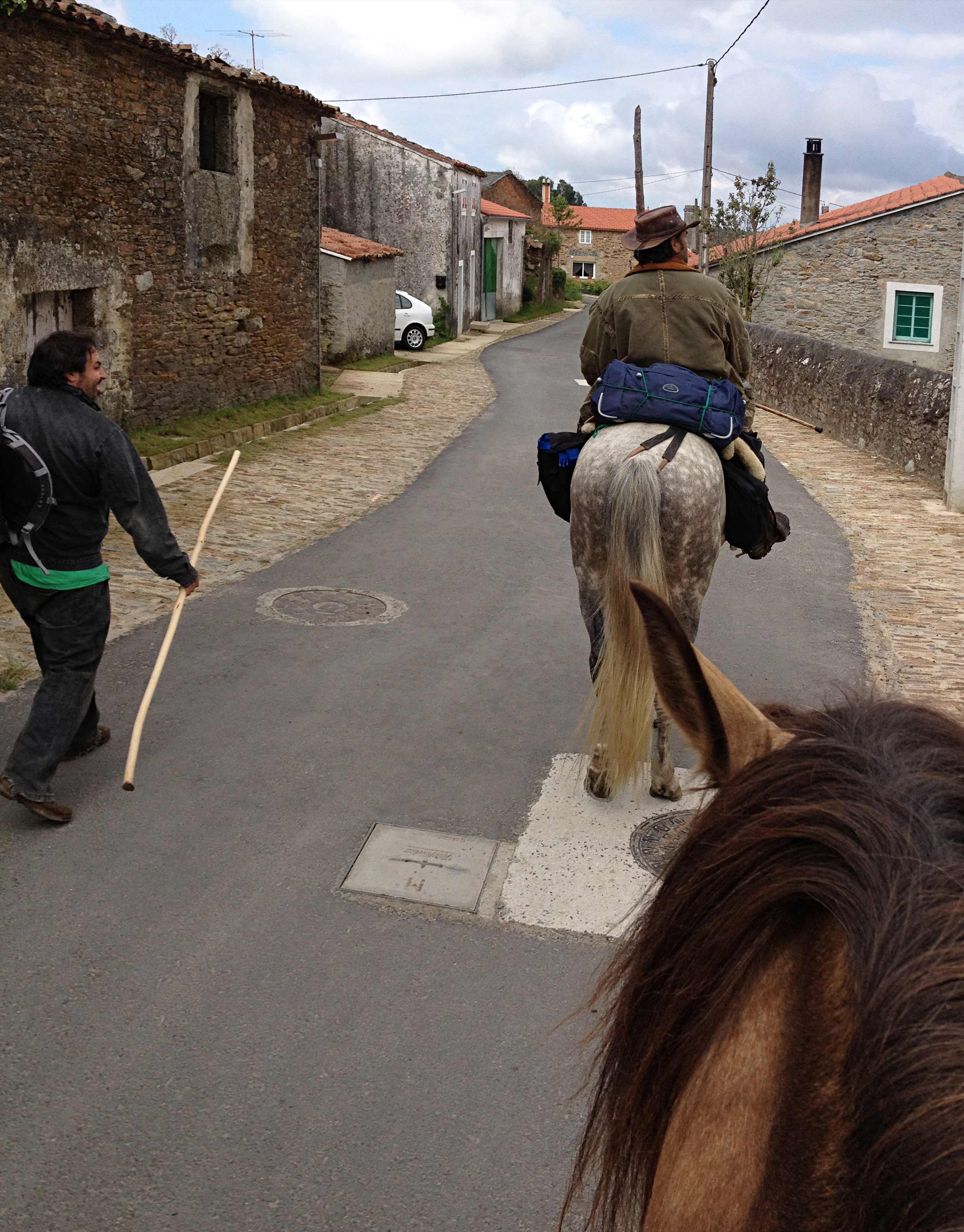
So it came to pass that I unexpectedly got to ride a horse as part of my camino, and it was an adventure. The men were two Spanish brothers and the son of one of them, who was doing their camino on horseback and neither of them spoke English. But it didn’t matter at all. The brother riding burst into song at regular intervals, while the other fed me fruits and berries he bought along the road at little stalls, and gave me a flower he pilfered from a garden we passed too.
The fountain in Boente where we stopped and watered the horses 2012 and today 2023.
I accompanied them all the way to Arzua, riding into town to the applause of the people sitting outside the cafés that lined the main road leading into town. They were going to stay here, and we dismounted by the small chapel in the centre of town. I thanked them profusely and left them to tend to the horses, feeling grateful for this experience that I will never forget. The Camino delivers magic when you need it the most.
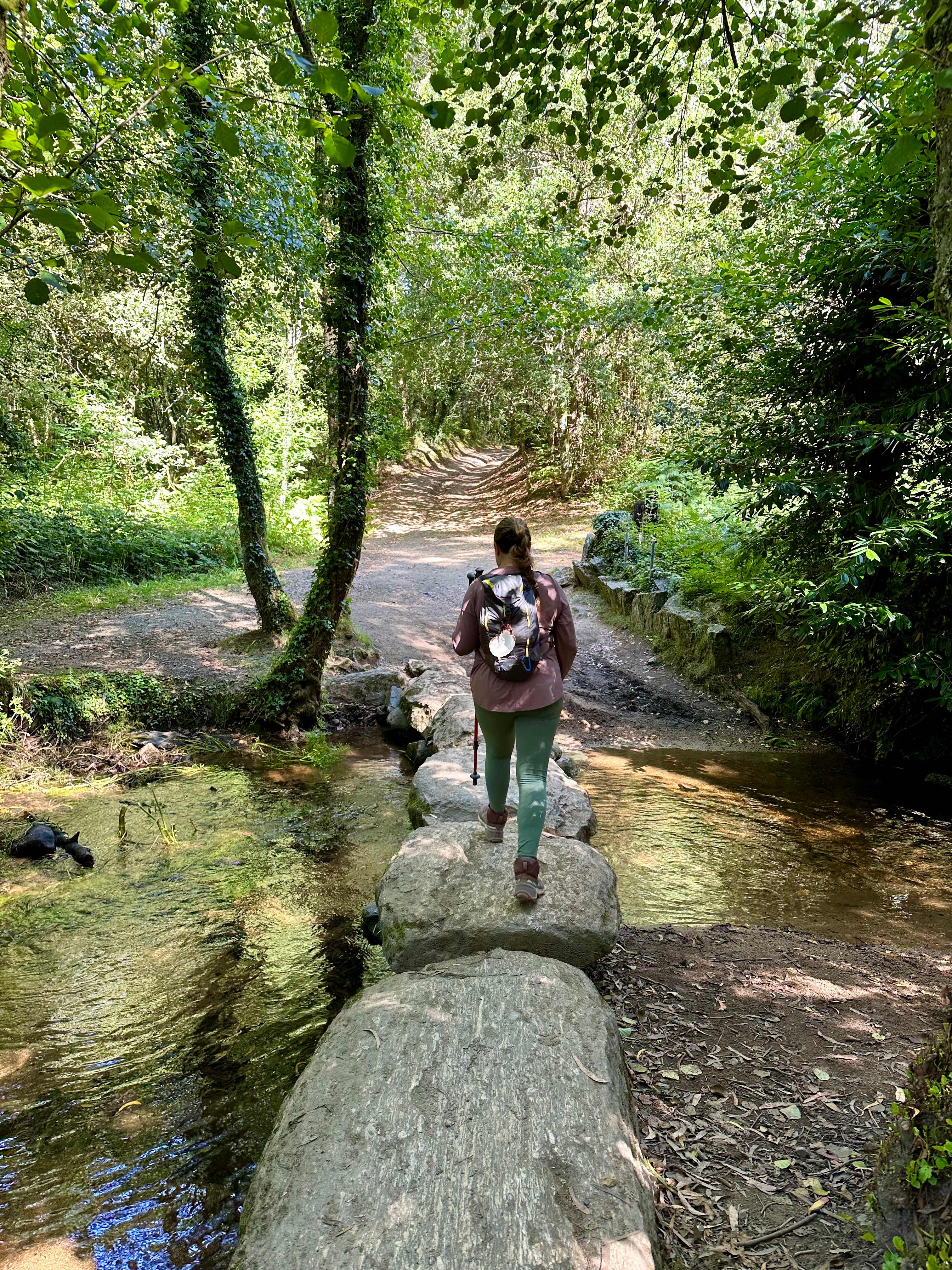
We pass one of the places I remember as well, a shallow riverbed that you cross by using the big boulders as a bridge.
Today’s walk takes us through shady forests of oak, chestnut, eucalyptus and pine, and across six river valleys, and involves many uphill and downhill slopes, of which several are steep. I am thankful my knee, although not okay, is not bothering me too much right now.
Eventually we stop for lunch, and I’m exhausted. Walking with the pros, as I call those who by now are skilled hikers, used to walking long distances for many hours every day, makes it a bit more challenging for me, because they don’t have to stop and rest as often as I need to. But I enjoy walking with Ann, and we have lovely conversations along the way.
A succession of cows passes by on the road, while we have lunch.
Here is one of the many peculiar, narrow buildings raised above ground that are scattered around the countryside. They used to be used as larders to keep the farm’s provisions safe from mice and rodents. This one is in Castañeda.
Crossing the medieval bridge we finally arrive in Ribadiso after 26,3 km and a solid eight hours walk with only one stop for lunch and a short stop for a quick drink. My feet are killing me, my knees are playing up again, and I’m in dire need of rest. But I made it here!
Ribadiso 2012
Ribadiso 2023
It’s a beautiful day, the sun is shining and I intend to enjoy what’s left of it to the fullest. Across the street is the only restaurant in this small hamlet, and here I find Bjarne and Grethel, when I eventually manage to get there. We exchange news as I wolf down a hearty dinner, before taking myself back to my room and a hopefully good night’s rest.
At least that was the idea. It turns out that tomorrow’s intended accommodation is not what I thought it was, so I spend a large part of the evening researching and booking a new place to stay and this means that I also have to rebook my backpacking service, so not the early night I was hoping for. Let’s see what tomorrow brings.
Check out my earlier posts to get the full context of this pilgrimage or my latest Camino, and sign up to be notified when the next post is released. If you enjoyed this post, please give it some love by sharing and liking it!
The Camino de Santiago is a pilgrimage rooted in medieval origins. It leads to the tomb believed to be that of the Apostle Saint James the Greater, in the crypt of Santiago de Compostela Cathedral. The Camino was, and still is, Europe’s oldest, busiest, and most well-known route.
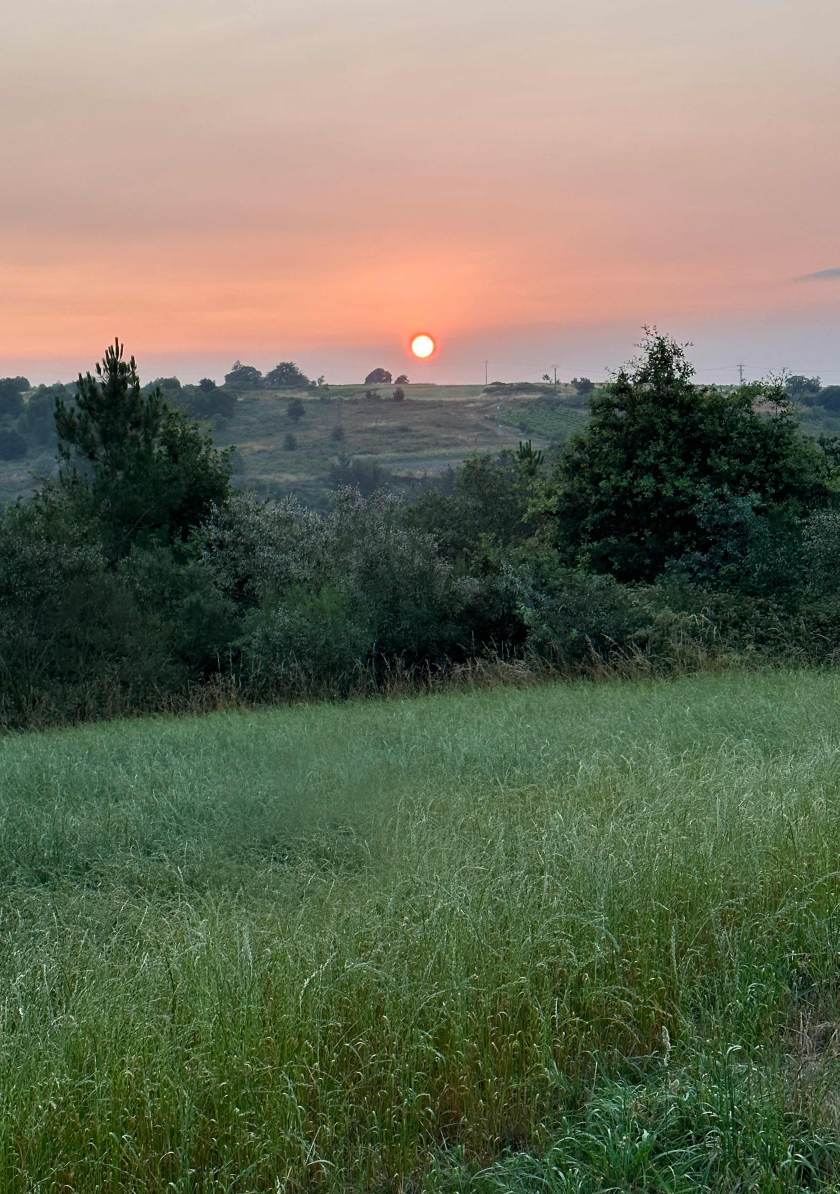
I never tire of these beautiful sunrises, the reward of early evenings and extremely early mornings. Today it’s uphill, uphill, and even more uphill for at least 15 km, right from Portomarín. However, it’s perfect walking weather, mostly overcast and occasionally drizzly. Even though it’s tough going, I’m enjoying myself.
A new-born calf, and is that the mama cow anxiously watching it from inside the barn?If so, why separate them?
A couple of times I pass the same couple, and on a particularly steep section of the Sierra Ligonde Mountain, I stop and rest on the same bench they are sitting on.
We chat for a while in English, and then I ask them where they are from. Sweden, they answer, and we burst into laughter when I reply that so am I! After this I continue to walk with Bjarne and Grethel for a while. Then they point out another Swede, Melek, and we all join forces till we reach a restaurant where we stop to have lunch.
We joke and say that it’s typical Swedish midsummer weather when we sit outside and eat, because it’s drizzling so that we don’t know if we have to take our plates and go inside, only to clear up the next second when we were all wearing rain gear.
Suddenly the Guardia Civil appears in the most tranquil of places…what could they be doing here?
After lunch we leave Bjarne and Grethel behind at the restaurant, as they are on the phone trying to book tickets home. It’s easy to walk beside Melek, because we have endless things to talk about, but it also feels very comfortable to walk in silence with him. In no time at all we become aware of that we are approaching what appears to be a large recreation area and we look at each other questioningly. No, what? Already? This can’t be a village; it must be a larger town. Can we really be in Palaís de Rei already?
Yes, we most certainly can, and we enter the town after the easiest 26 km and 8 hour hike I’ve experienced! He accompanies me as I look for the house where I’ve booked a small room. As I’m interested in homes, I have chosen a couple of places to stay that have been or are real homes, and this is one of them. It turns out to be just as wonderful as I hoped.
This amazing old house with lots of atmosphere and charm was the home of Leopoldo, his wife and their eight children. The house was run down when they acquired it and took a lot of work. Later, one of the daughters who’s a dab hand at interior design, took over the refurbishing. Today, three of the sisters still live here, all in their 70s and 80s. Now they are on vacation, otherwise it would have been great to have had a chat with them.
I settle into my cosy little room and have a wonderfully warm shower. Then go out in search for something to eat, but all the places I find open at 7 o’clock. Two pilgrims, a young man and woman cross the street at the same time as me. Do you want to join us for a drink? they ask, as we are right outside a bar. Yes please! The Camino community spirit continues, and we settle down for a lovely chat till it’s time for them to visit the Mass and me to have dinner.
I find a really good restaurant whose specialty is octopus, so I have the traditional dish Pulpo Gallega, octopus with boiled potatoes, which sounds like a strange combination, but turns out to be delicious. Then I head back to the house, and yes, I manage the tricky old lock on the front door and before I know it I’m in my comfy bed and it’s lights out, feeling very grateful for this day.
Check out my earlier posts to get the full context of this pilgrimage or my latest Camino, and sign up to be notified when the next post is released. If you enjoyed this post, please give it some love by sharing and liking it!
The Camino de Santiago is a pilgrimage rooted in medieval origins. It leads to the tomb believed to be that of the Apostle Saint James the Greater, in the crypt of Santiago de Compostela Cathedral. The Camino was, and still is, Europe’s oldest, busiest, and most well-known route.
I leave Sarriá behind me not long after 6 AM when it’s still dark. The first thing I meet is an express train rushing past me just by the trail! If I wasn’t fully awake before, I am now. The sunrise is particularly beautiful today, and I’m enjoying my walk. The first 10 km feels easy enough, and I rest for the first time at a café after two hours, where I have my breakfast, a coffee and a French omelette.
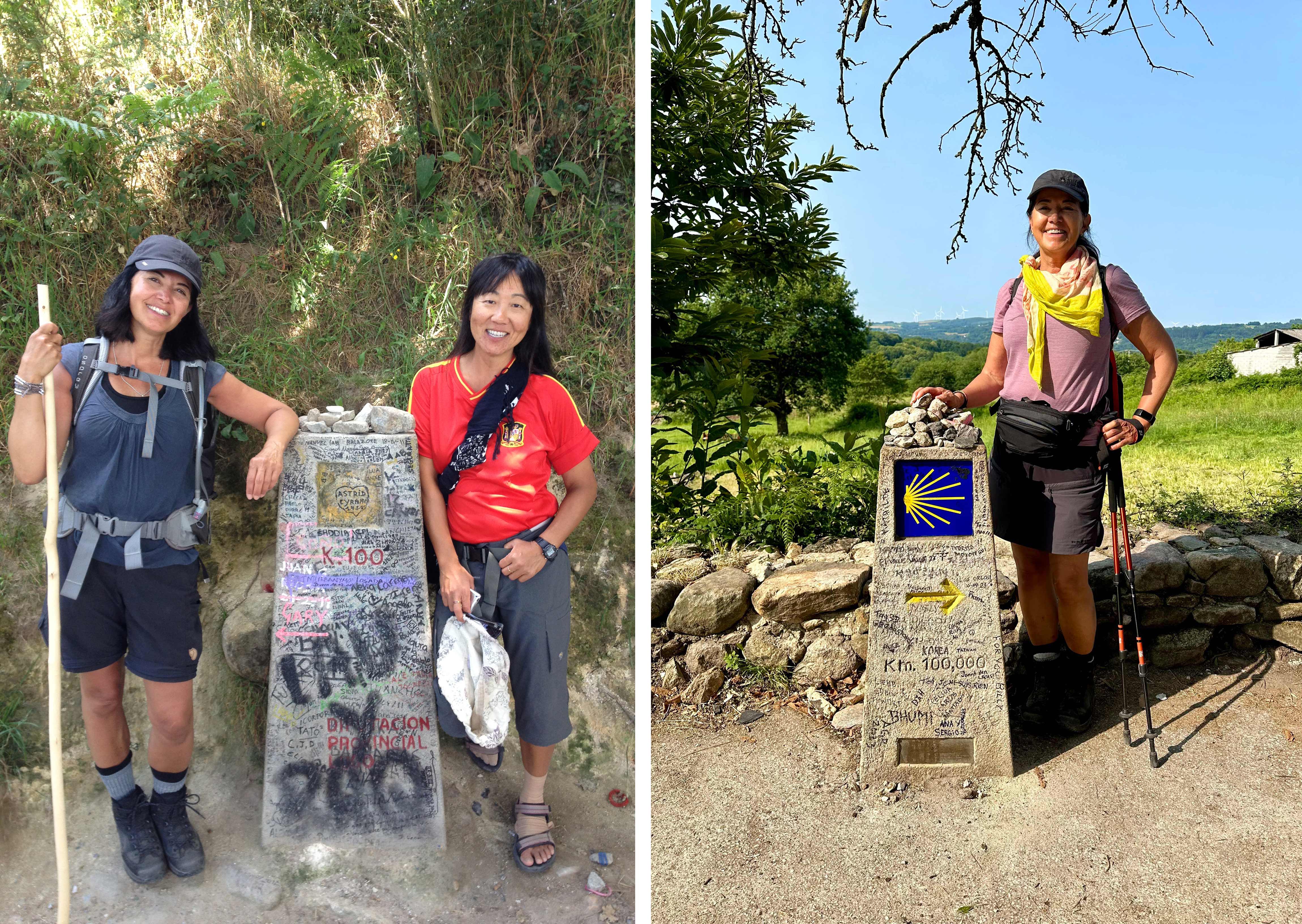
I ponder again the difference walking the Camino from the last time, and the community spirit I’m missing when Wilfried catches up, and we continue to walk together. At A Pena we come cross the 100 km milestone! It has a huge significance, especially to those pilgrims who have hiked about 688 km up till now all the way from St. Jean Pied de Port. But, wait a minute! This isn’t how I remember this milestone from the last time! Yes, they have made changes since then, such as making new milestones and moving the locations to be more correct.
The 100 km milestone in 2012 and now 2023.
About halfway, where I remember I sat on a stone wall to rest, we suddenly come across a bagpiper in the middle of nowhere! We stop to listen for a while and when we leave, we discover he even has his own stamp for our pilgrim passports. I remember the bagpipers in Santiago de Compostela, one of the first things you encounter when entering the big square in front of the cathedral, and I feel the first stirring of emotion at this reminder of the end not being far away now.
Every day you need at least two stamps from Sarría to Santiago de Compostela. Before Sarría you only need one. You can get them at every hostel, pension, hotel, café, restaurant and at some of the churches. This is to show the pilgrim office you have walked the trail from wherever you started, to receive your credentials at the end in Santiago de Compostela.
Then we reach Mercadorio, and I really want to stop, as I have very fond memories of staying here the last time. We decide to stay and enjoy an exquisite goat cheese salad as a late lunch. Who is sitting outside if not Teresa, whom I met earlier and then in quick succession comes Tine and after her Suzanne! Suddenly we share not only a table, but also our day and our experiences as if we’ve always known each other and in an instant, I have that Camino community feeling that I’ve been missing! The Camino doesn’t give you what you want, but what you need…
It’s getting hotter by the minute, so I want to keep going because I know Portomarín is…on a hill of course, as all the towns here seem to be, so Wilfried and I press on.
I wish I had taken photos of the bridge crossing the river Miño, and the very steep staircase leading up to the town, that’s part of the original medieval bridge, but alas I’m too exhausted by the time we reach Portomarín. Once again it it’s not so much the distance that’s the issue here, as this stretch is only 23 km, but the heat that totally zaps the energy out of me. The weirdness of the steep staircase by the way, has its explanation. The bridge and several other historical buildings where moved, stone by stone, to higher ground when the dam was built across the river to create the Belesar reservoir in 1962.
I have a very nice room at the heart of this small town, on the cobbled main street with handsome stone colonnades. After a well-deserved shower and hair wash, I crash into bed for my siesta. Suzanne and I have a date to have dinner together, but she’s also all done too, so I grab a Caldo Galega at the nearest restaurant and have an early night to get an early start and hopefully beat the heat tomorrow.
Check out my earlier posts to get the full context of this pilgrimage or my latest Camino, and sign up to be notified when the next post is released. If you enjoyed this post, please give it some love by sharing and liking it!
The Camino de Santiago is a pilgrimage rooted in medieval origins. It leads to the tomb believed to be that of the Apostle Saint James the Greater, in the crypt of Santiago de Compostela Cathedral. The Camino was, and still is, Europe’s oldest, busiest, and most well-known route.
Today’s hike goes through the glorious Gallic landscape, that I love. There are two routes to choose from, the one via Samos and the other San Xil. I choose the San Xil route, because it’s the one I hiked last in 2012, and would like to re-experience it.
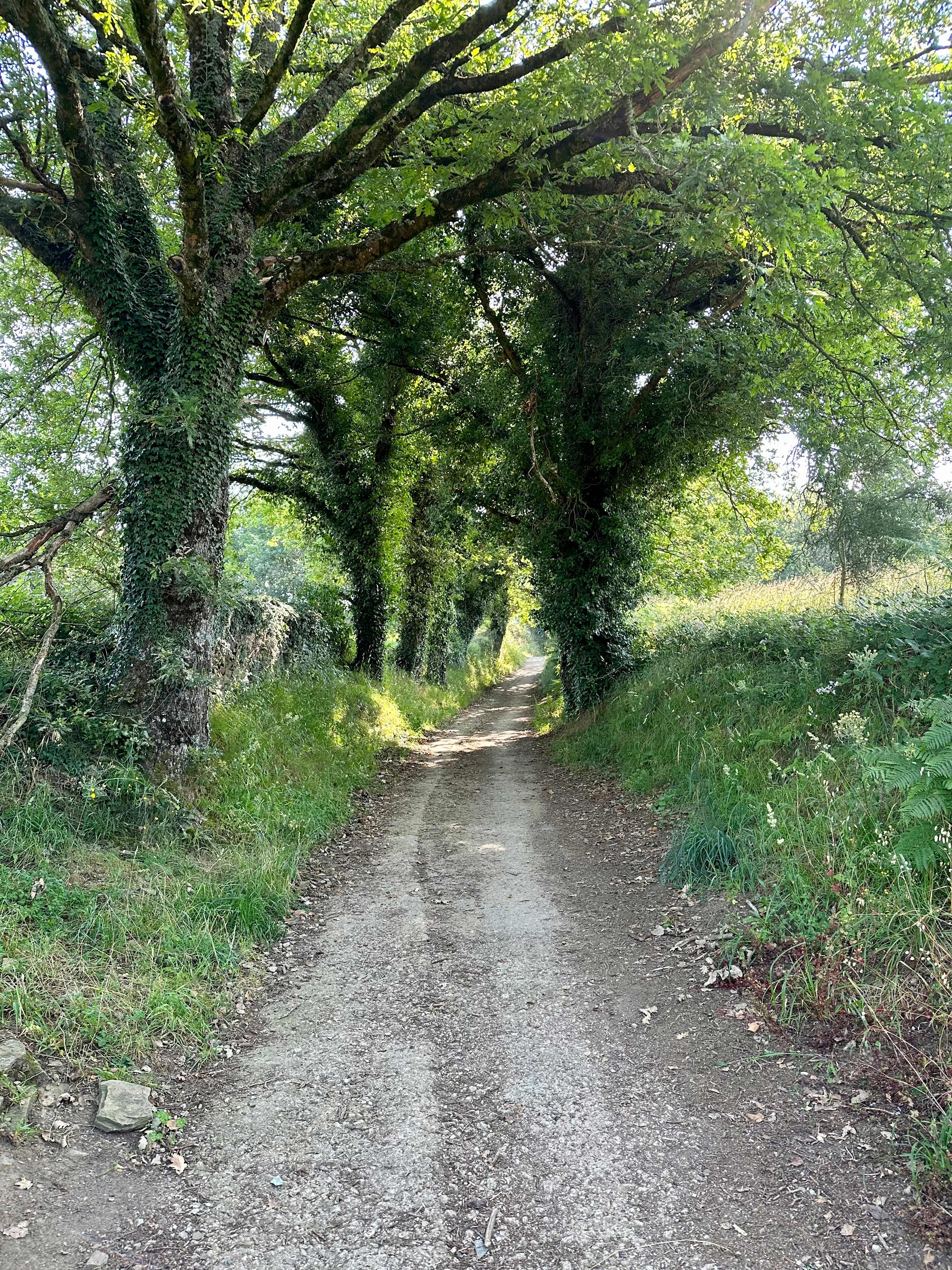
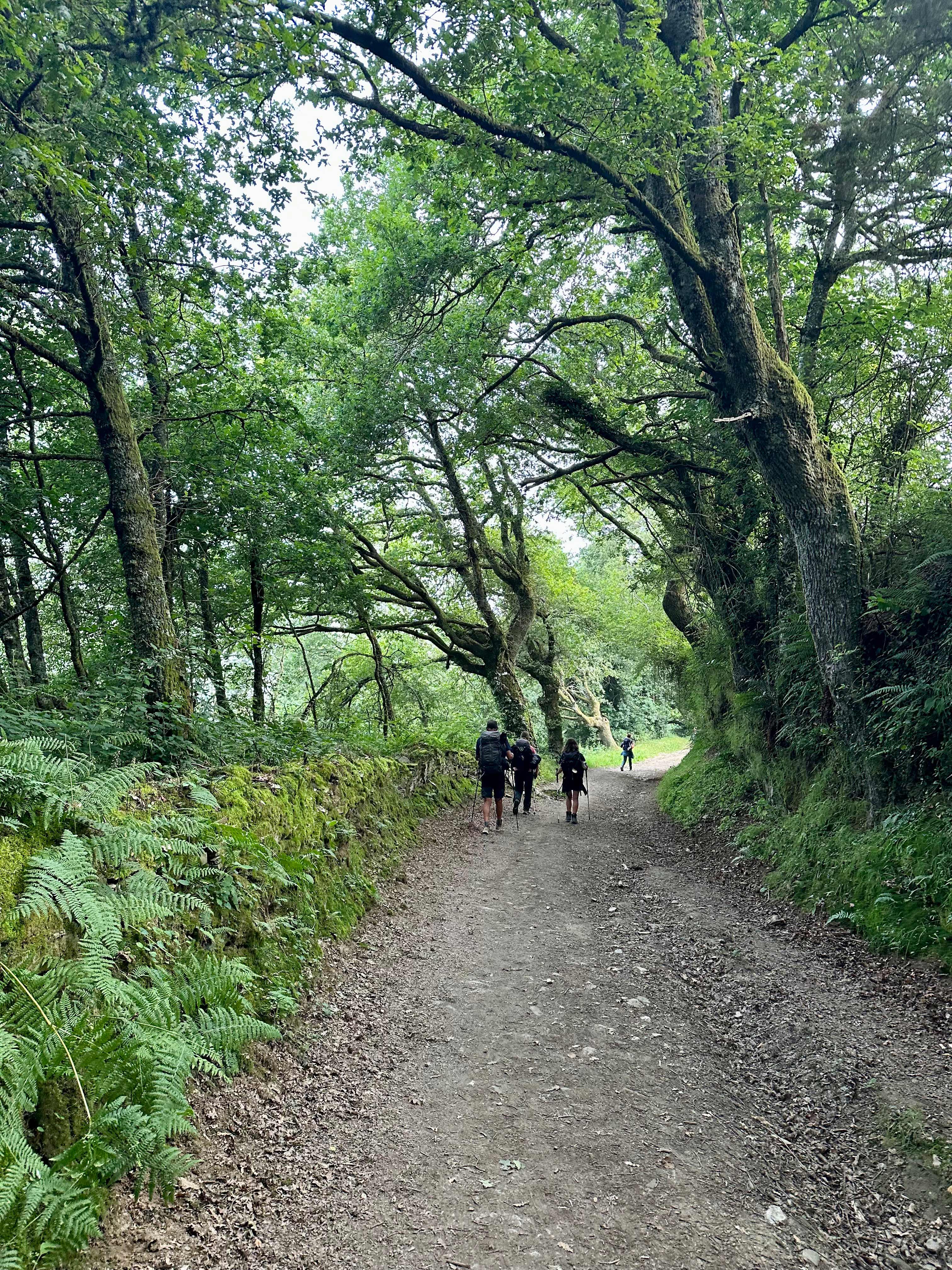
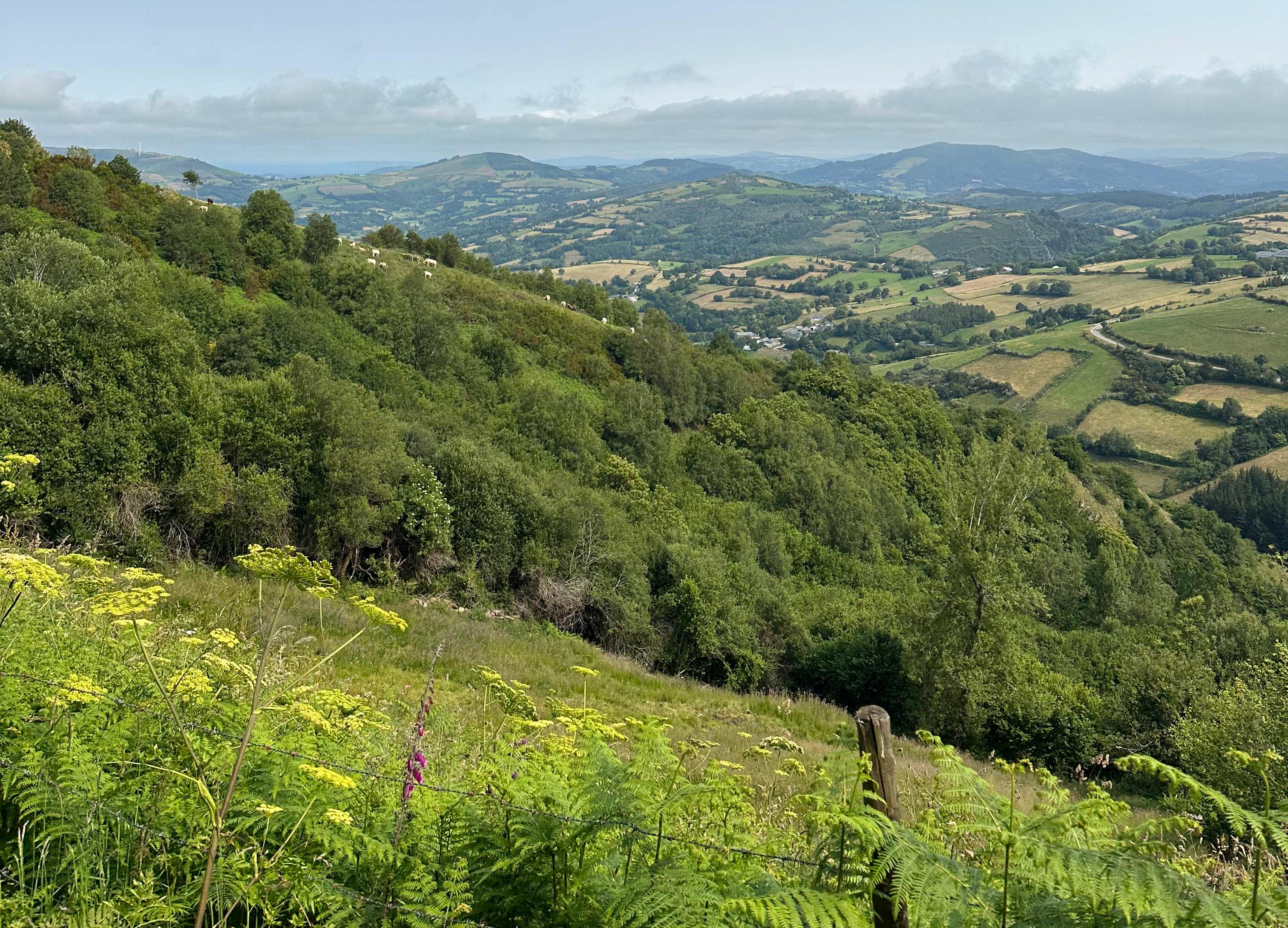
It is just as beautiful as I remembered if not more, as the sunshine makes the scenery even more attractive. Higher up on the mountain it is pleasantly cool, and a large part of the trail is shaded by trees. I absolutely love walking these appealing sheltered trails.
In 2012, people made their way mainly by following the hand-painted yellow arrows and milestones. Today, the routes are clearly marked, so it’s quite impossible to get lost.
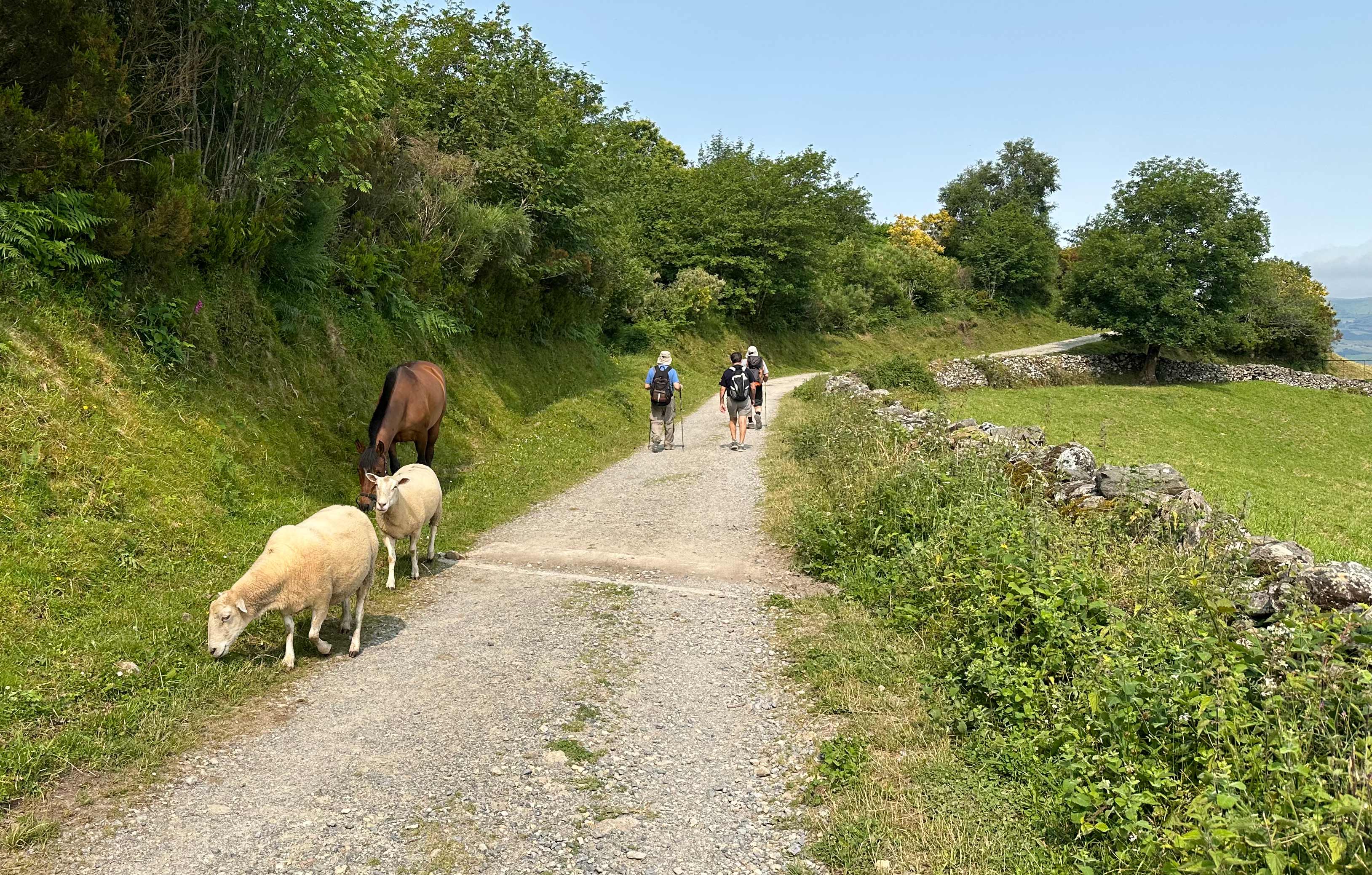
I see many more pilgrims now, but no more than I can walk alone for many stretches. From time to time, I keep company with a Spanish mother and her daughter, and several times I bump into a German pilgrim, Wilfried, and we chat.
Me in 2012 and 2023 in the same place. Notice how the vegetation has grown!Same happy face though.
On the way I walk pass many active farms, and today I share the path with a tractor for a while, which just about fits in the narrow road. I like to observe the daily to-ings and fro-ings of the locals, as it’s also a reminder that the Camino is just a small part of the everyday life of wherever we pass.
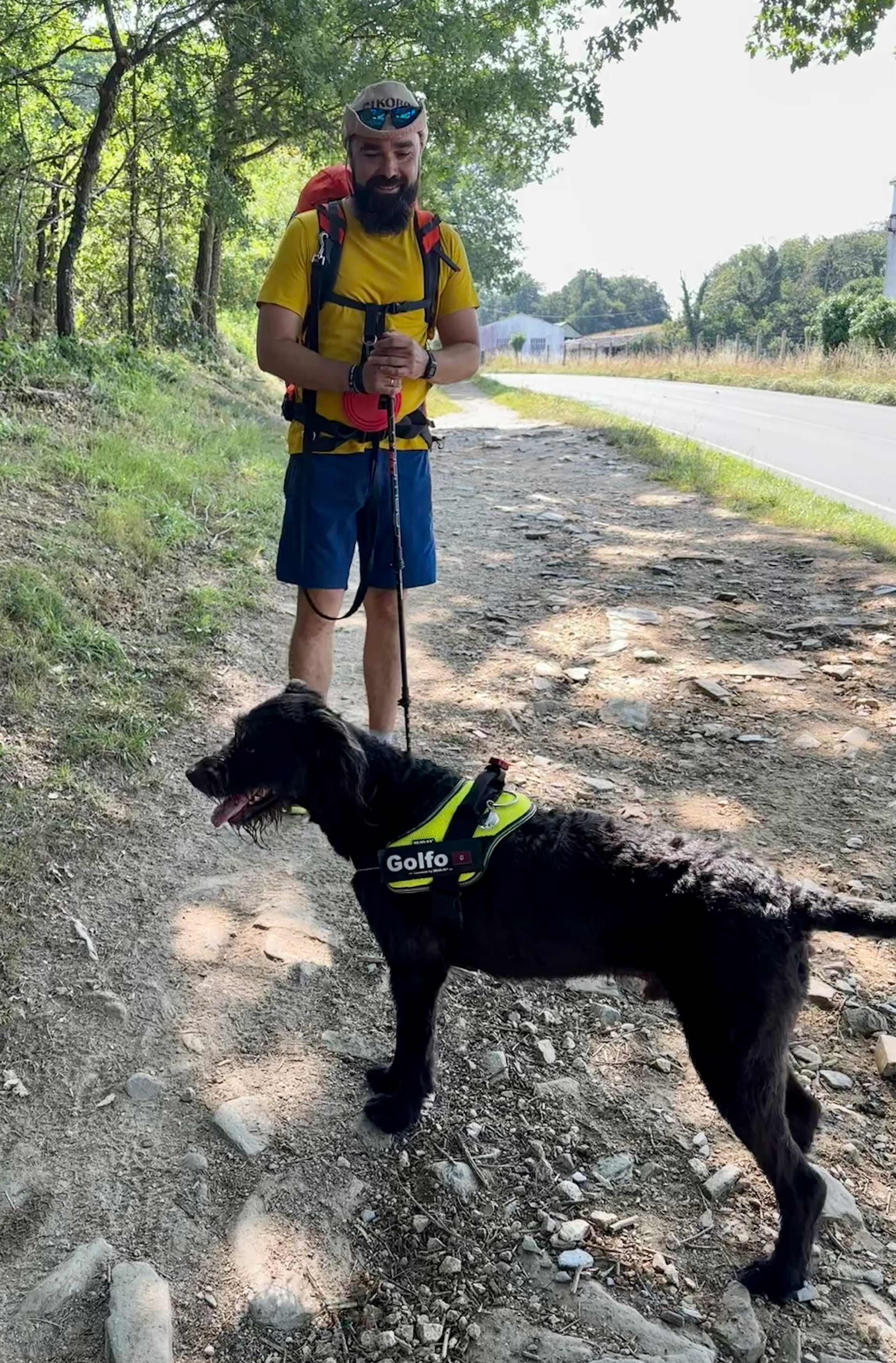
Many complete their Camino on bike, and I’ve met a few on horseback, but several times I have also met a very nice dog called Golfo and his equally nice human on the trail, on their joint Camino from León to SdC. We meet up again just before Sarría, on the flat, open stretch leading up to Sarría. Since it has become hot again, I ask him if I can latch on to them and draw on their energy to get into town. Of course, he answers and draws the parallel to cycling, where going in a group is always faster and easier than cycling alone. In Swedish, we have a saying for this and call it “taking someone’s back”, roughly translated.
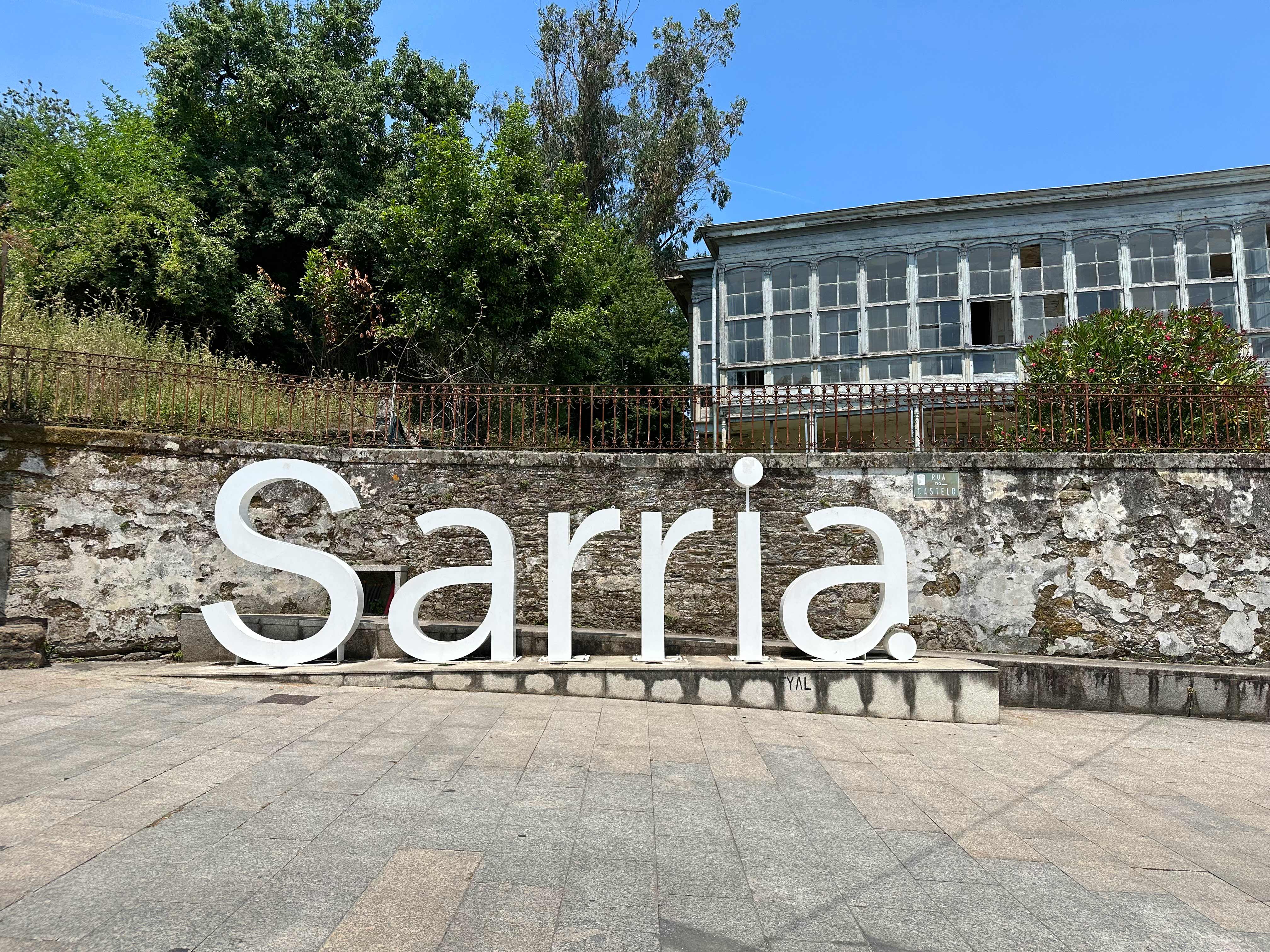
So, I follow them into Sarría, and is grateful for this much needed extra boost of energy. Sadly, they are staying at the very beginning of the town, whereas it turned out, I’m at the very opposite side, just where the town ends. Of course, Sarría also is built on a hill, so this means slowly climbing step by step, to the very top. Phew!
Luckily there are signs like this one outside a restaurant I pass that cheers me up.
The advantage of staying on top of a hill is the view, which luckily my next room has in this very nice guest house, so I’m more than happy. I also get to use the old-fashioned concrete laundry tub on the terrace where I wash all my clothes and hang them to dry in the scorching sun.
Sitting in the shade, after exploring the town a bit, I’m very pleased with my day, and happy to be on the Camino again.
Check out my earlier posts to get the full context of this pilgrimage or my latest Camino, and sign up to be notified when the next post is released. If you enjoyed this post, please give it some love by sharing and liking it!
The Camino de Santiago is a pilgrimage rooted in medieval origins. It leads to the tomb believed to be that of the Apostle Saint James the Greater, in the crypt of Santiago de Compostela Cathedral. The Camino was, and still is, Europe’s oldest, busiest, and most well-known route.
Late start today after unfortunately only getting 4,5 hours of sleep. There are some significant changes on the Camino since my last time here. One of them is that they have created alternative routes. At O Cebreiro the forest track I took 2012 is now a complimentary route, and the new one I take today is the official route. It’s a delightful soft forest path running parallel to the road, but you never actually see it through the dense forest, and sometimes it runs on a different level from the road too. It’s foggy and everything gets damp, including me, but it’s a pleasurable hike.
The first café I get too is dark and crowded. I grab a quick coffee at the counter and want to exit, but there’s a bunch of Americans getting ready to leave too, and one of the girls has left a backpack right in front of the door. I wait for her to move it so I can pass, and she replies rather impertinent that I can just jump over it. This ill-mannered response, and other aspects of egocentric displays of human behaviour that I have come across this time on the Camino, such as walking and listening to loud music without headphones, are today’s food for dark thoughts and reflections on attitudes, respect, and basic pilgrim code of conduct. It feels like a relatively new phenomenon and is probably why the discussions are high on the various forums about ‘real pilgrims’ and ‘tourists’.
Good thing for me that I can refocus on the beauty around me, because everything has a magical feeling when shrouded in fog. It’s a steep climb to Alto do Poio, but once up there the view is magnificent! We are above the clouds up here and mountain peaks rise like floating islands. There is a café here and I have a large glass of freshly pressed orange juice and a tortilla for brunch, and I’m as good as new and ready to go.
It feels great to be back in Galicia. I hike alone all day and it’s very satisfying to walk sheltered from the sun on these covered paths, some almost like tunnels, covered as they are by trees and vegetation. I’m loving every second.
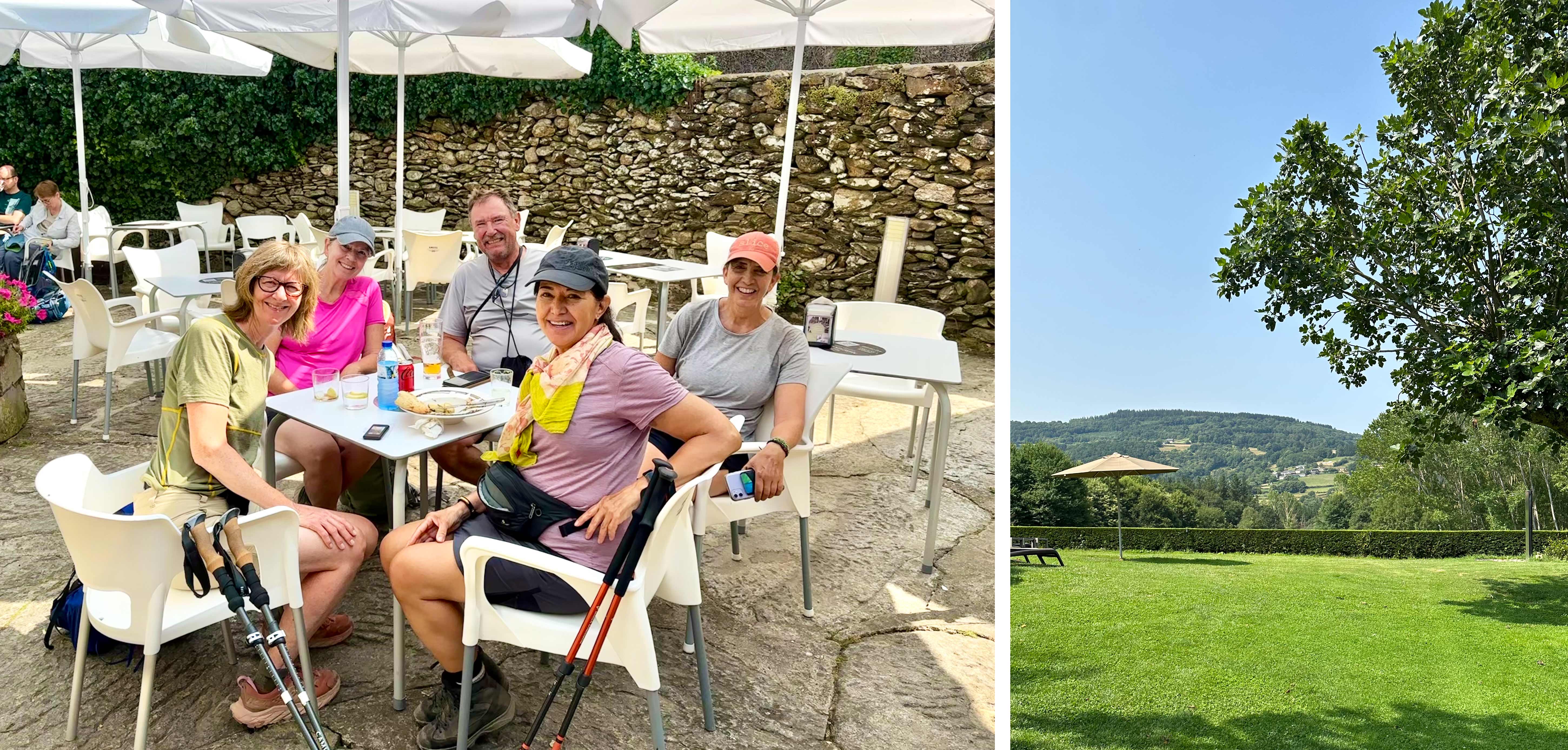
New places have popped up, as the café in Filobal and here I stop for brunch number two. Yes, the rude girl, her sister and father come here too but I sit out at the back in the coolness of the garden, where I’m entertained as I eat my customary salad mixta, as a pilgrim (peregrino) from one group comes forward and impromptu sings to another group of female pilgrims (peregrinas).
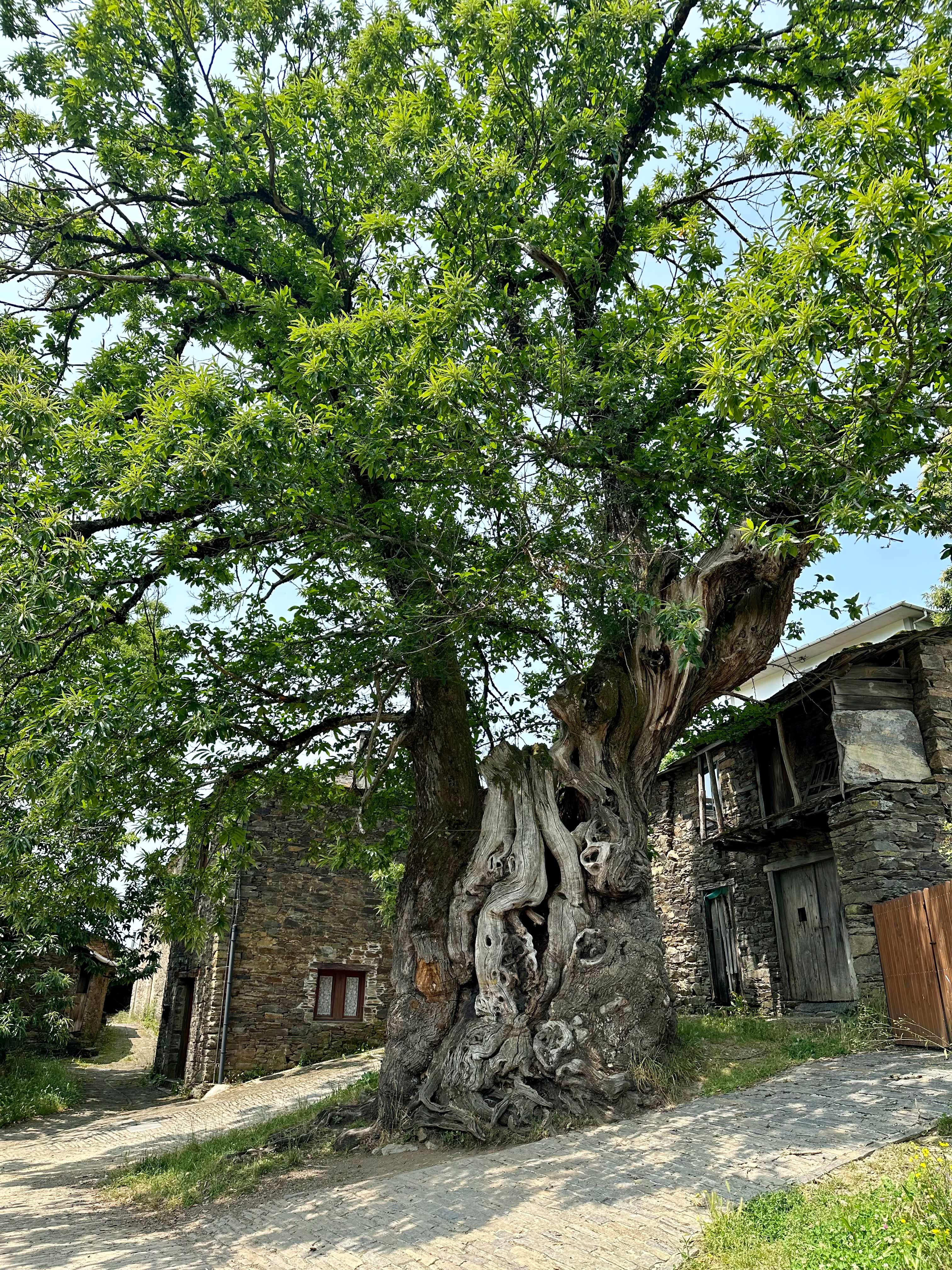
Just before Tricastela I pass the famous centennial chestnut tree of Ramil, 850 years old, according to data provided by the Superior School of Rural Engineering of Madrid. Over eight centuries are reflected in its almost nine meters in perimeter, I read. Yes, it’s a handsome old tree, and it’s impossible to walk past without taking a photo of it, standing as it is right on the path, as if to welcome pilgrims on their arrival at Tricastela.
I am happy to say that I enter Tricastela in an orderly fashion, legs intact and feeling strong. Six days of continuous hiking has paid off. This is after all a 21 km hike, mostly downhill. This small village located in the province of Lugo is a historic Jacobean place.
Tricastela means three castles, probably Celtic forts, that used to surround the city, but none of them remain. It was an important stop for medevial pilgrims and still is today, as it’s an attractive village with many lodgings. I’m staying in an old schoolhouse, beside the church, run by Jules and Sonya, a friendly Belgian couple who live themselves on the top two floors. I chose this place partly for its architectural uniqueness and partly for their communal breakfasts, and I’m warmly welcomed when I arrive.
I have dinner at Complexo Xacobea, a wonderful restaurant just down the road, where I enjoy the tastiest meal so far! My three-course pilgrim menu tonight is Caldo Gallega, a homemade vegetable soup typical of this region, which has quickly become a favourite, followed by grilled meat and sausages with two delicious sauces and a glass of red wine. Fresh fruit in crème fraiche completes the meal, and I’m one happy customer.
Afterwards, I sit outside the church in the evening sun by the river, and I don’t want the day to end just yet. Tomorrow, I hike to the city of Sarria. I didn’t stay there the last time, and can’t remember very much from when I passed through the town, so it’ll be a new experience.
Check out my earlier posts to get the full context of this pilgrimage or my latest Camino, and sign up to be notified when the next post is released. If you enjoyed this post, please give it some love by sharing and liking it!
The Camino de Santiago is a pilgrimage rooted in medieval origins. It leads to the tomb believed to be that of the Apostle Saint James the Greater, in the crypt of Santiago de Compostela Cathedral. The Camino was, and still is, Europe’s oldest, busiest, and most well-known route.
















































 Bohemialife