My ‘John the Scot’ would have been proud of me. I’m up by 4 AM and rearing to go at 5 AM sharp. When I descend the stairs, I find that the lovely Spanish family are all packed and ready too! We head out and it’s pitch-black outside. Never has a purchase felt so good as my new headlamp does now. Outside it’s eerily devoid of other people, even as we pass O Pedrouzo, and we walk for quite some time before daylight breaks and we begin to see anything at all.
The darkness doesn’t bother me, but the teenagers Paula and Maria keep close, especially when a dog jumps up and start barking at us, seemingly coming from nowhere. Luckily there is a sturdy fence between us. We walk all the way past the airport before we come to the first café that’s open, Porta de Santiago. I am grateful to have a much-needed breakfast here, having walked non stop for 13 km, which is halfway to Santiago de Compostela. Here I meet some of my new Camino friends, Wilfried, Ann, and Melek when they pass by.

Perfect walking weather

We continue and the girls and I walk fast and leave their parents behind us. At Monte de Gozo we pass a large albergue, and here I say goodbye to Paula and Maria. They are going to wait for their parents to catch up, so they can enter Santiago de Compostela together.
I’m entering the town now and begin to recognize some of the landmarks. Just before we come into the center I pass a pilgrim, José from Costa Rica, and we team up for the very last stretch. He’s a very nice guy and tells me has hurt his feet and is walking alone, as he hasn’t been able to keep up with his group. At one point we pass a small procession where one of them is playing the bagpipe, and suddenly I feel very emotional.

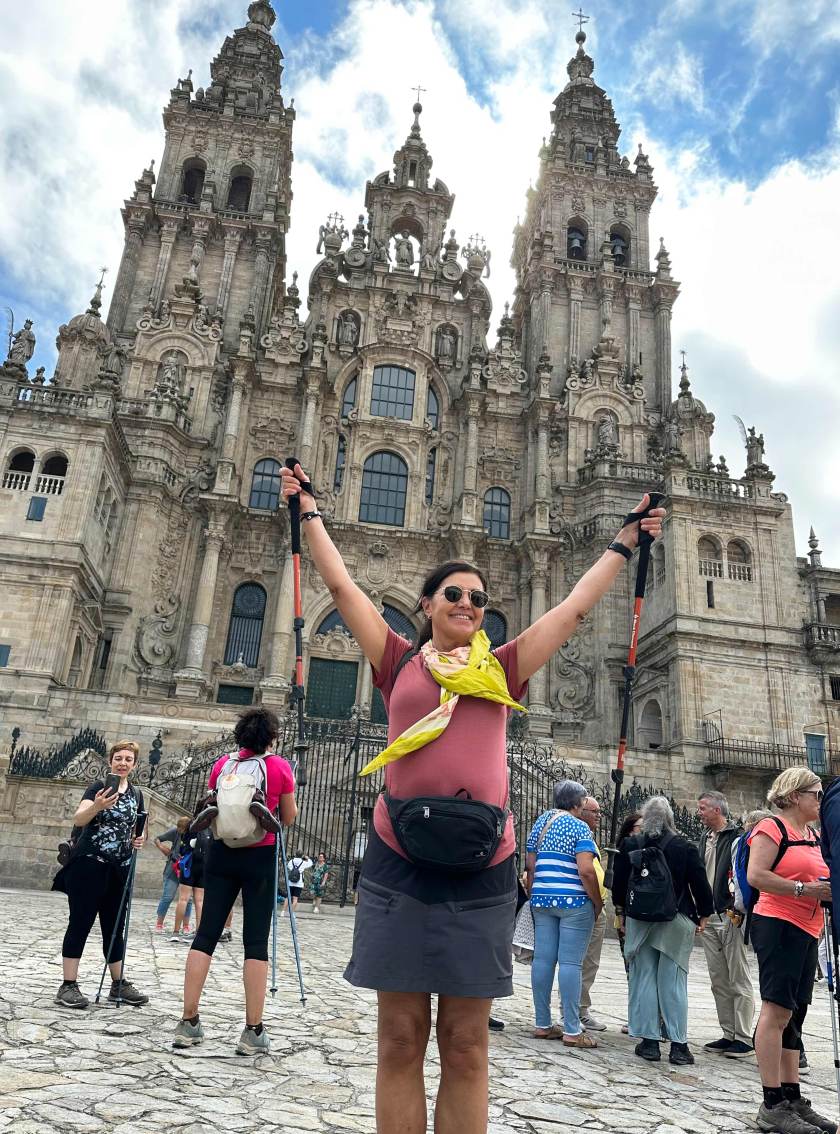
We have arrived! After ironically having to ask for directions for the first time on the very last 100 meters in the throng of small streets, we round the corner and here it is, Praza Obradoiro, the large square in front of the Cathedral. Many different emotions pass at the same time. We take the obligatory photos and grin at each other. Yes! I’m really here! We are joined by the pilgrims that have arrived and still are arriving. As it’s noon and I want to attend the pilgrim mass at 12.30, we say goodbye and I join the que into the cathedral.
Once inside it turns out to be completely full. I see James and greet him and find a small space behind one of the massive pillars. I am extremely aware of my not-so-fresh-from-the-hike state, sandwiched as I am between some elderly presumably local citizens. I can’t see anything of the mass itself that’s going on the other side of the pillar, but turn inward instead.
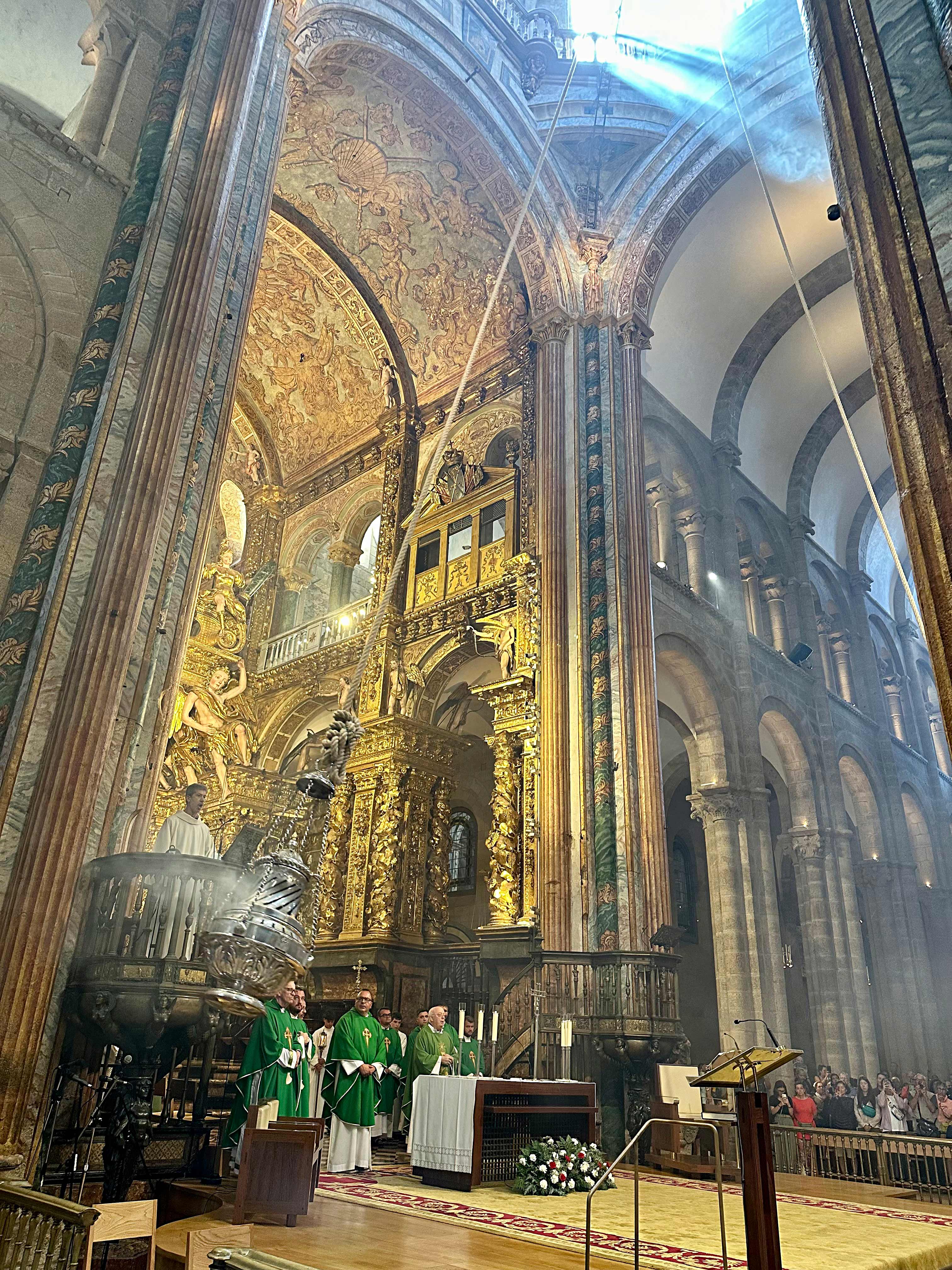
Then a group of cloaked men suddenly appear and move away those of us standing around the pillar, as it turns out to be the very one the Boutafumiero’s ropes are attached to. Now I’m free to move to edge of the nave, and just like that I’m in the very best position to witness this spectacular event.
Last time I was lucky enough to see this giant incense burner swinging, but didn’t have high hopes this time as it doesn’t happen at every mass. The tiraboleiros as these six red cloaked men are called, hold on to the ropes and perform the ritual of swinging the Botafumeiro back and forth across the cathedral. This ritual was originally used to disinfect the sweaty and possibly sick pilgrims. It is spectacular to see how it swings all the way up and almost touches the high ceiling of the cathedral. For me, the Mass represents the finale of my Camino. For others who have walked the whole distance, it’s not enough to arrive in Santiago de Compostela to achieve a sense of closure. Many pilgrims therefore continue to hike the Camino to Cape Fisterra and Muxia.

After the mass I find my way to the hotel I’m staying at and check in, have a wonderful shower, and wash my hair. There is a lot of unpacking to do, and I don’t mean clothes. The Camino has so many levels to it, apart from walking different stages. Good thing I’m staying here for another day to land.
The next day I go back to the main hotel to have breakfast, and here I meet Jo, a lovely pilgrim from the US, and we instantly bond. She started all the way in France, from Le-Puy-en-Velay, a French Camino that connects with the Camino Frances at St. Jean Pied de Port and is going to continue to both Portugal and Scotland to continue hiking! What an inspiration she is!
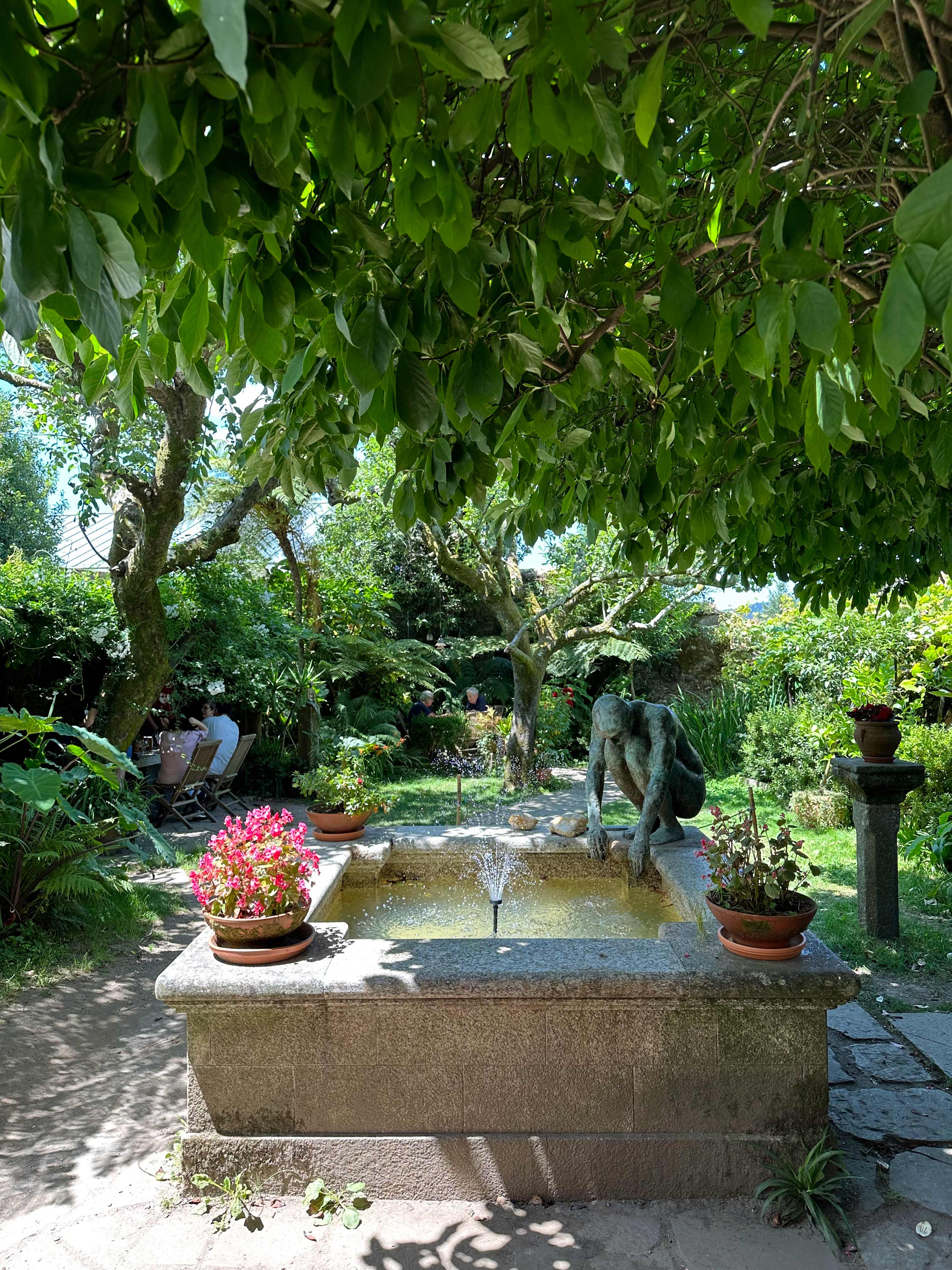
In town I seek out places I remembered from the last time, such as the then restaurant is now the Café Jardin Costa Vella, on Rúa Porta de Pena. It has a beautiful and serene garden with a fountain, a perfect spot to relax and enjoy a huge slice of chocolate cake.

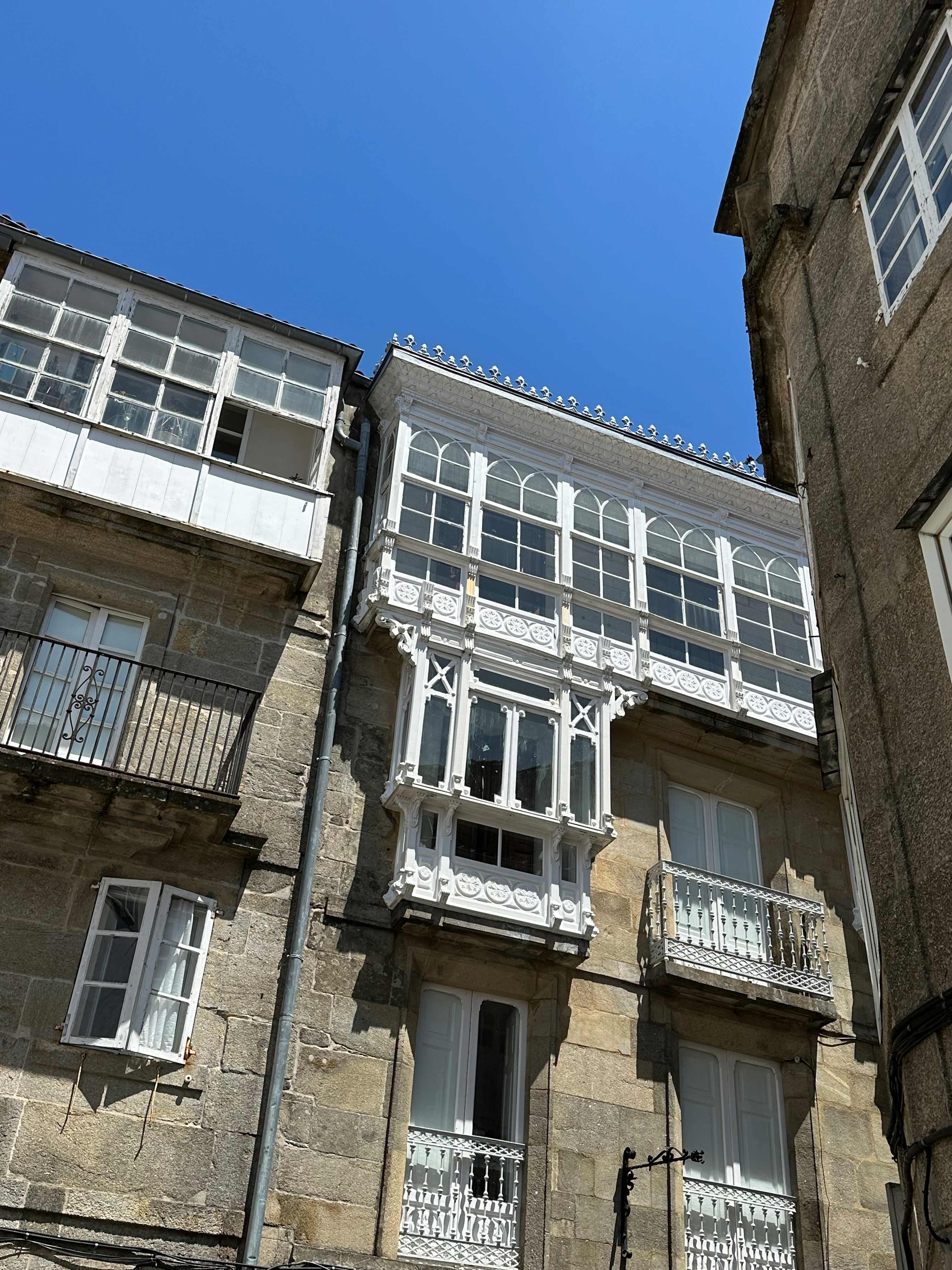
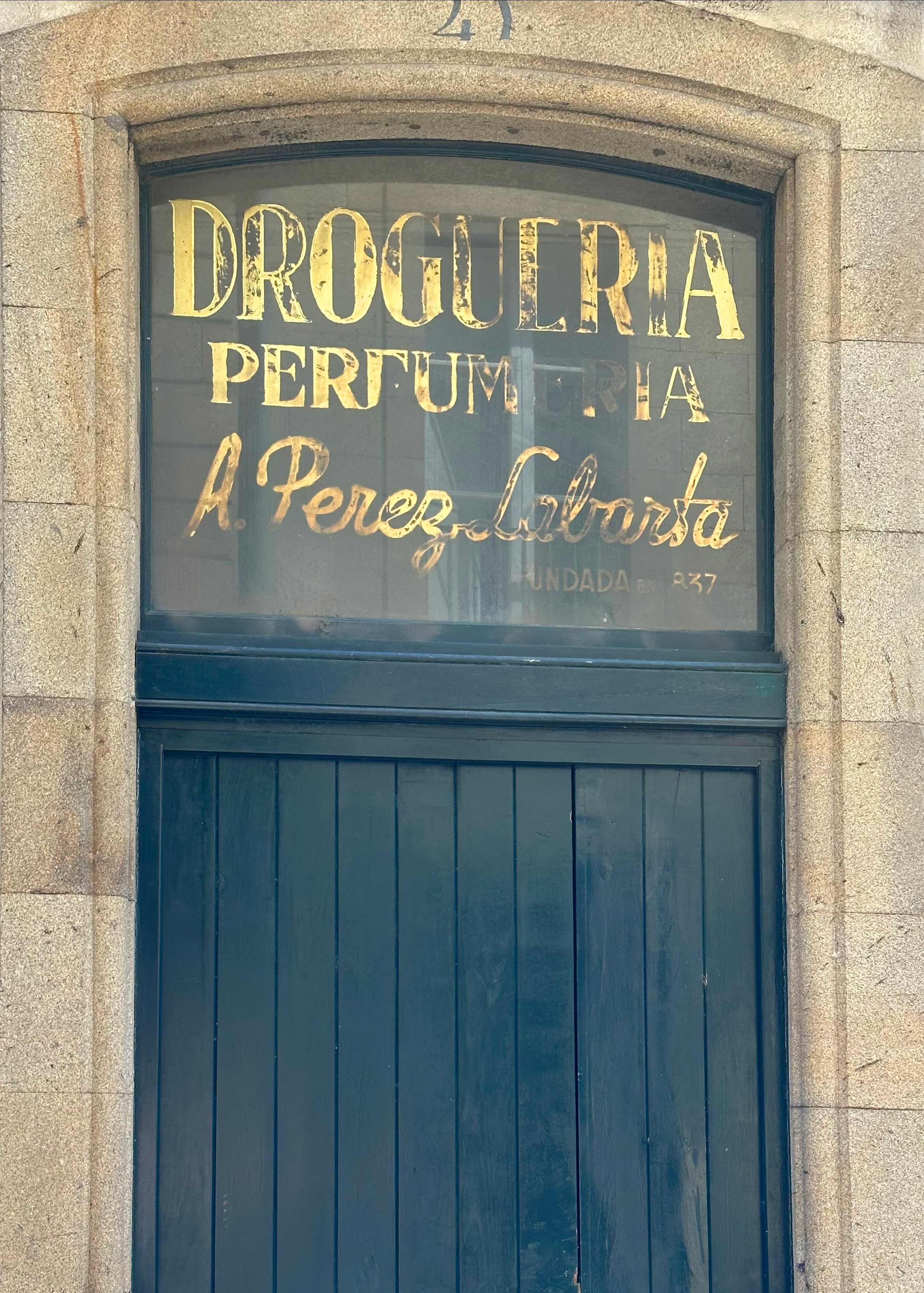

I also find new favourites. The Greenhouse on Rúa da Conga, a vegetarian restaurant just around the corner from me has an excellent Hong Kong noodle dish that I have two days running. I meet up here with Suzanne and Tine on my last night to celebrate.
My Camino has come to an end. Tomorrow a new journey begins. I’m going south to the Italian Riviera to visit my niece. But that’s another story…
These are my own musings and reflections. I highly encourage you to make your own.
Check out my earlier posts to get the full context of this pilgrimage or my latest Camino, and sign up to be notified when the next post is released.
If you enjoyed this post, please give it some love by sharing and liking it!
All photos copyright Anita Martinez Beijer © All rights reserved
More about the Camino
The pilgrimage routes have been here for more than ten centuries as means to go to Santiago de Compostella. The old routes go between the towns because there you were safe. They were not meant to be beautiful or scenic. You walk on tarmac and where ordinary people live and work, but also on paths through breathtakingly beautiful nature.
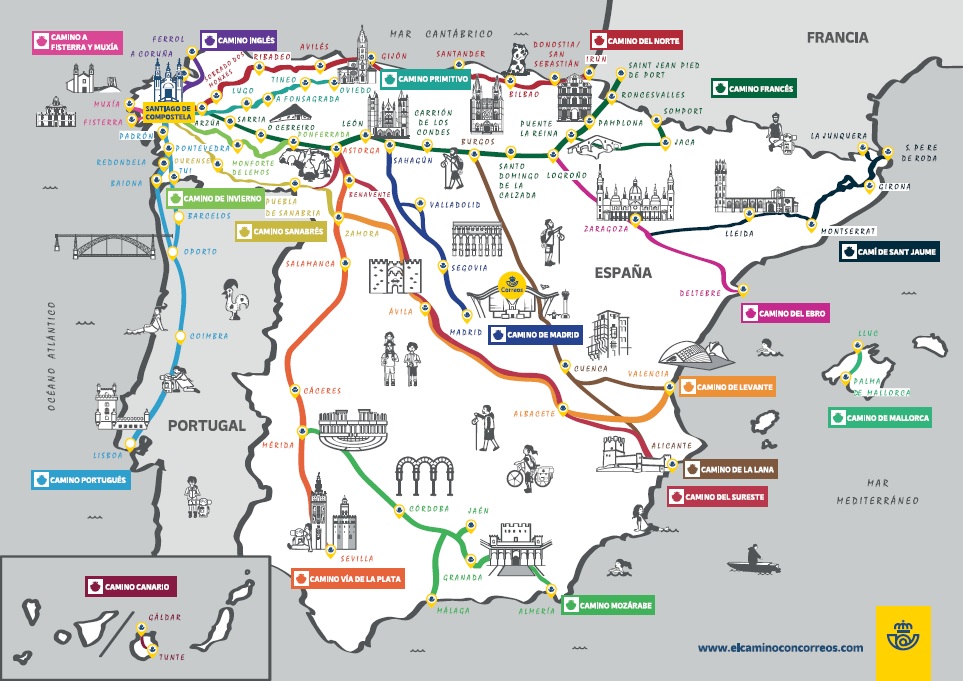
There are many different Camino routes in Spain, all leading to Santiago de Compostela. The Camino Francés is the most popular route, starting from St. Jean Pied de Port in France. Others are Camino del Norte from Irun, Camino Vasco Interior from Irun, Camino Aragones, Camino de Levante from Valencia, Ruta de la Lana from Alicante, Camino de Madrid, Camino Mozarabe from Granada, Vía de la Plata from Sevilla, Camino Portuges from Lisbon, Camino Primitivo from Oveido, Camino Ingles from Ferrol and lastly Camino de Fisterrais, from Santiago de Compostela to Cape Fisterra, once believed to be the edge of the world on the Atlantic coast of Galicia, where you can continue to Muxia.
Image credit: https://www.elcaminoconcorreos.com/en/blog/camino-santiago-maps
So, what does it mean to undertake a Camino? Some do their Camino on horseback, others on bicycle, but most walk. Some walk a whole section of a route such as this one, the Camino Frances or the Way of St James as it’s also called, which takes 30 days or more. Other split a route in shorter sections over many years, or only walk a part of a route, and then again others walk the same section they have grown to know and like over and over. There are even pilgrims who walk or bike from their homes in other countries, which is what pilgrims did for many centuries, when there were no other means to reach Santiago de Compostela. It may have begun as Christian pilgrimage, but today people from all walks of life and faiths do their Camino.
Why do people decide to do a Camino? My guess is there may be as many answers to this as there are pilgrims.
Walking the Camino is a journey of discovery, both external and internal. In any case, being able to cover huge distances just using your own legs is amazing. For many, it is a spiritual journey. Some want to explore all the historic buildings and sites. Others for their love of nature and the ever-changing scenarios. Many see the Camino as a path of self-discovery. Some view it as an adventure and want to share this venture with their partner, family, or friends. Others yearn for freedom and need to go solo. Some need to get away from their ordinary life to get clarity on an important issue. People may be grieving, or need to do something physically strenuous to reduce a heavy burden they carry. A few do it because they want to celebrate something big like a 70th birthday. For others, it’s about challenging themselves physically. Or it could simply be a time for a much-needed break from life and being part of a great community.
I just read about a Spanish man who did his very first Camino on bike with a co-worker. The second time he went with his girlfriend who then became his wife. The third time was with his son after losing his job, and the fourth time he went with his whole family. Each time on different routes, with different lengths and in different seasons, but all with a personal meaning, the Camino is an integral part of his life’s journey.
It doesn’t matter if it’s your very first time or if you’re a seasoned repeat walker, if you’re young or in your 70s or 80s, no one leaves the Camino without it having had some kind of impact on their life. Most remember their Camino as, if not life-changing, one of the best they’ve experienced.
My humble take is that anyone who decides to walk the Camino, on this or any of the other many pilgrim routes, is a pilgrim. It doesn’t matter if you are Christian or not, weather you walk alone, in a group, with your dog, ride a horse, or a bike. Sleep in alberges, hostel’s, pensions, hotels, or tents. Whether you carry your backpack or send it with a transport service, because no one knows what burdens anyone is shouldering, carrying his or her backpack or not.
Here I would like to refer to the books written by John Brierley, who sadly passed this very day when I finished my Camino, if you want to delve deeper. His books, which became his life’s work, describe the various Camino routes, and has helped countless pilgrims, including myself, over the many years the books have been around, updated and reissued.
John Brierley obituary | Travel | The Guardian
John Brierley RIP | THE CONFRATERNITY OF SAINT JAMES
The Camino de Santiago is a pilgrimage rooted in medieval origins. It leads to the tomb believed to be that of the Apostle Saint James the Greater, in the crypt of Santiago de Compostela Cathedral. The Camino was, and still is, Europe’s oldest, busiest, and most well-known route.
 Bohemialife
Hola Anita! Soy Julián, el dueño de Golfo (de Triacastela a Sarria). Sólo quería decirte que, con tu permiso, te “robo” la foto que nos hiciste a Golfo y a mí y que me alegra leer que llegaste bien a Santiago. Un saludo y ¡buen camino!
LikeLike
Hola Julián! ¡Qué bueno saber de ti! Por supuesto, tienes que tomar la foto y yo puedo compartir nuestra reunión. ¡Espero que tú y Golfo estén bien! ¡Buen Camino!
LikeLike